⚠️ MEDICAL DISCLAIMER
This article is for informational and educational purposes only and is NOT a substitute for professional medical advice, diagnosis, or treatment.
Chronic sleep problems, including frequent nighttime awakenings, can indicate serious underlying medical or mental health conditions. Always consult your physician or a board-certified sleep specialist if you experience persistent sleep disruptions.
This article shares general information and should not replace professional medical evaluation and treatment.
🆘 If you experience sudden difficulty breathing, chest pain, or other concerning symptoms during the night, call 911 immediately.
Why Do I Wake Up at 3 AM Every Night? (A Doctor Explains the Real Reason + How to Fix It)
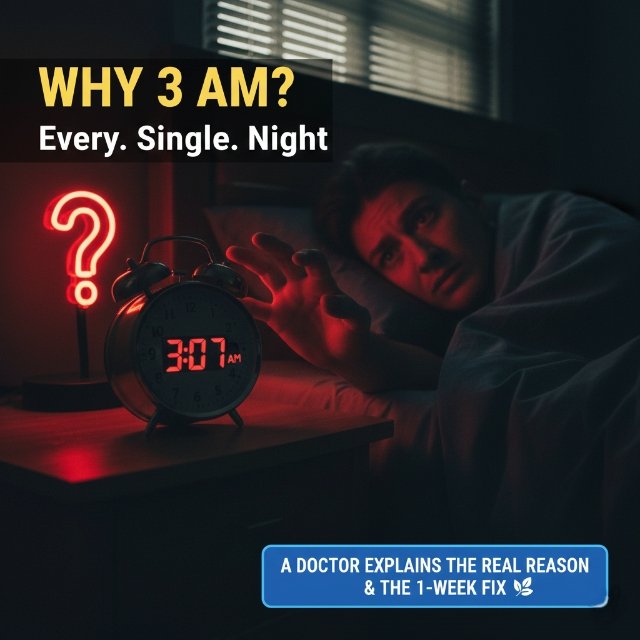
It’s 3:17 AM.
Your eyes snap open. Wide awake. Heart slightly racing. Mind starting to churn.
You check the clock. 3 AM. Again.
Like clockwork. Every. Single. Night.
You lie there, frustrated, knowing you need sleep. But your brain won’t cooperate.
Sound familiar?
You’re not alone. In fact, 35% of adults wake up at least three nights per week at roughly the same time (usually between 2-4 AM).
And here’s what’s wild: There’s a scientific reason WHY it’s always around 3 AM.
I spent months waking up between 2:30-3:30 AM every single night.
I tried everything:
❌ Melatonin (made me groggy, still woke up)
❌ White noise machines (helped initially, then stopped working)
❌ Sleeping pills (worked temporarily, created dependency)
❌ “Just relaxing and going back to sleep” (impossible when your mind is racing)
Nothing worked long-term.
Then I discovered something that changed everything:
My 3 AM wakings weren’t random. They were caused by a specific, fixable issue that most people (and even some doctors) don’t understand.
Once I identified and fixed the root cause, the 3 AM wakings stopped within ONE WEEK.
I’ve been sleeping through the night consistently for 4 months now.
In this article, I’ll explain:
Why you wake up at the SAME time every night (the science is fascinating)
The 7 most common causes (one is probably affecting you)
Exactly how to fix it based on YOUR specific cause
What worked for me (and thousands of others)
If you’re tired of being exhausted, frustrated, and watching the clock tick past 3 AM every night—keep reading.
This might finally give you the answers you’ve been searching for.
The 3 AM Phenomenon: Why That Specific Time?
First, let’s address the elephant in the room: Why is it always around 3 AM?
Short answer: Your body’s natural sleep cycles and circadian rhythm.
Here’s the science:
Your sleep happens in 90-minute cycles:
Each night, you cycle through these stages multiple times:
Stage 1: Light sleep (5-10 minutes)
Stage 2: Deeper sleep (10-25 minutes)
Stage 3: Deep sleep / slow-wave sleep (20-40 minutes)
Stage 4: REM sleep (10-60 minutes)
Then the cycle repeats.
By 3 AM, you’re typically 4-5 hours into sleep.
This is when:
You’ve completed 3-4 sleep cycles
You’re transitioning from deep sleep to lighter sleep
Your body temperature is at its lowest
Cortisol (stress hormone) naturally starts rising (preparing you to wake)
You’re in your lightest sleep phase of the night
Translation: 3 AM is when you’re most VULNERABLE to waking up.
But WHY do you wake up and can’t fall back asleep?
That’s where the root causes come in.
Something is triggering your body to fully wake during this vulnerable window—and then keeping you awake.
Let me show you the 7 most common culprits (one of these is almost certainly affecting you).
Cause #1: Blood Sugar Crash (The Most Common Culprit)
This was MY problem. And it’s the most overlooked cause of 3 AM wakings.
Here’s what happens:
Evening (6-10 PM):
You eat dinner (maybe pasta, bread, dessert—high carb)
Blood sugar spikes
Insulin released to bring it down
Blood sugar normalizes
Late night (10 PM – 2 AM):
You’re sleeping
Blood sugar gradually drops (normal)
Your body uses stored glucose
2-4 AM (THE CRITICAL WINDOW):
Blood sugar drops LOW (potentially too low)
Your body panics: “We need energy NOW!”
Releases stress hormones (cortisol, adrenaline)
These hormones WAKE YOU UP (so you’ll eat and raise blood sugar)
Result: You wake up at 3 AM with:
Heart racing slightly
Feeling alert (adrenaline)
Slightly anxious or “wired”
Mind racing
Can’t fall back asleep
Your body literally woke you up as a survival mechanism.
Who is most affected:
People who eat high-carb dinners
People who eat dinner early (5-6 PM) and nothing after
People with blood sugar dysregulation
People with insulin resistance or pre-diabetes
People on low-calorie diets
People who skip dinner or eat very little
How to tell if this is YOUR issue:
You wake up at 3 AM with:
✓ Slight hunger (not ravenous, but noticeable)
✓ Heart racing or pounding
✓ Feeling “wired” or alert
✓ Slight shakiness or jitteriness
✓ Mind racing with anxious thoughts
✓ Difficulty falling back asleep for 1-2 hours
Test: Eat a small protein + fat snack before bed for 3 nights (see “The Fix” below).
If you sleep through the night = Blood sugar was the issue.
The Fix:
Strategy 1: Bedtime Snack (Game-Changer)
Eat a small protein + fat snack 30-60 minutes before bed:
Best options:
Small handful of almonds + cheese
Apple slices with almond butter
Greek yogurt (plain, full-fat)
Hard-boiled egg
Turkey or chicken (small portion)
Cottage cheese
Avocado on whole grain toast
Avoid:
Pure carbs (crackers, cereal, fruit alone)
Sugar (candy, cookies, ice cream)
Large meals (causes indigestion)
Why this works:
Protein + fat digest slowly
Keeps blood sugar stable through the night
Prevents the 3 AM cortisol spike
Gives body steady energy supply
I added a small handful of almonds + cheese before bed.
Within 3 nights, I stopped waking at 3 AM.
Strategy 2: Balance Your Dinner
Eat a balanced dinner (not just carbs):
Include:
Lean protein (chicken, fish, tofu)
Healthy fats (avocado, olive oil, nuts)
Vegetables (fiber slows glucose absorption)
Complex carbs (sweet potato, quinoa) NOT refined carbs
Avoid:
Pure pasta dishes
White bread/rice heavy meals
Dessert right before bed
Sugary foods late evening
Strategy 3: Eat Dinner Later (If Needed)
If you eat dinner at 5-6 PM and go to bed at 10-11 PM:
That’s 5-6 hours without food
By 3 AM, you’re 9-10 hours fasted
Too long for some people
Consider:
Eating dinner 7-8 PM
Or adding a small bedtime snack
For me, the bedtime snack alone fixed the problem.
Cause #2: Stress & Cortisol Dysregulation (The Anxiety Wakeup)
If you wake up with your mind immediately racing with worries, this is you.
Here’s what’s happening:
Cortisol (stress hormone) follows a daily rhythm:
Normal pattern:
Lowest: 2-3 AM (middle of sleep)
Starts rising: 4-6 AM (preparing you to wake)
Peaks: 8-9 AM (fully awake and alert)
Declines throughout day
When you’re chronically stressed, this rhythm gets disrupted:
Disrupted pattern:
Cortisol spikes during the night (should be low)
Spike happens around 2-4 AM
Wakes you up suddenly
Mind immediately starts racing
Feels like anxious, “wired” awakening
Your stress from the day is literally waking you up at night.
Who is most affected:
People with high stress (work, relationships, finances)
People with anxiety disorders
People going through major life changes
People who worry excessively
People who “can’t turn off their brain”
People dealing with trauma or PTSD
How to tell if this is YOUR issue:
You wake up at 3 AM and immediately:
✓ Mind starts racing with worries
✓ Thinking about work, problems, to-do lists
✓ Feeling anxious or stressed
✓ Rehearsing conversations or scenarios
✓ Feeling “wired” despite being tired
✓ Takes 1-2 hours to calm mind enough to sleep
No hunger. No physical symptoms. Just mental activation.
The Fix:
Strategy 1: Evening Stress-Reduction Routine
Create a 30-60 minute wind-down routine before bed:
What to include:
Meditation (10-20 minutes) – Insight Timer app (free)
Gentle yoga or stretching
Reading (not on phone/tablet)
Journaling (brain dump worries onto paper)
Warm bath or shower
Breathwork (4-7-8 breathing)
Avoid:
Work emails after 7 PM
Stressful conversations before bed
News or social media (triggers stress)
Planning/problem-solving right before sleep
I started doing 15 minutes of meditation + journaling every night.
Within 1 week, the 3 AM racing thoughts stopped.
Strategy 2: Journaling Before Bed (Critical)
Write down everything on your mind:
10-15 minutes before bed, write:
All worries, concerns, fears
Tomorrow’s to-do list (gets it out of your head)
Problems you’re trying to solve
Conversations you need to have
Why this works:
Brain can “let go” because it’s written down
Reduces nighttime rumination
Gives closure to the day
My journal prompt:
“What’s on my mind right now? What am I worried about?”
Then write until there’s nothing left.
Strategy 3: The 3 AM “Worry Time” Technique
If you wake at 3 AM with racing thoughts:
Don’t fight it. Use this technique:
Tell yourself: “I can worry about this at 8 AM. Not now.”
Keep notepad by bed – jot down the worry in 2-3 words
Practice 4-7-8 breathing (described below)
Repeat: “This can wait until morning. I’m safe right now.”
4-7-8 Breathing:
Inhale through nose: 4 counts
Hold: 7 counts
Exhale through mouth: 8 counts
Repeat 4 times
This activates parasympathetic nervous system (calms you).
Strategy 4: Magnesium Supplement
Magnesium calms the nervous system.
Magnesium Glycinate: 300-400mg before bed
Reduces cortisol
Calms anxiety
Improves sleep quality
Doesn’t cause grogginess
Check with doctor first (especially if on medications).
Cause #3: Sleep Apnea (The Hidden Breathing Problem)
This is SERIOUS and often undiagnosed.
What happens:
Sleep apnea = repeated breathing pauses during sleep.
Here’s the cycle:
You fall asleep
Airway partially collapses (especially during deep sleep)
You stop breathing (10-60 seconds)
Oxygen levels drop
Brain panics: “Wake up! You’re suffocating!”
You partially wake (might not fully remember)
Breathing resumes
You drift back to sleep
Repeat 5-30+ times per night
By 3 AM, your body has been through this cycle dozens of times.
Your sleep is severely fragmented. You wake up exhausted despite “sleeping” 7-8 hours.
Who is most affected:
People who snore loudly
People who are overweight (excess neck tissue)
People over 40 (muscles weaken with age)
Men (more common, but women get it too)
People with large neck circumference
People who sleep on their back
People with nasal congestion
How to tell if this is YOUR issue:
Signs you might have sleep apnea:
✓ Loud snoring (partner complains)
✓ Partner witnesses you stop breathing
✓ Gasping or choking sounds during sleep
✓ Wake up gasping for air
✓ Severe morning headaches
✓ Extreme daytime fatigue (despite 7-8 hours “sleep”)
✓ Dry mouth or sore throat upon waking
✓ High blood pressure
✓ Wake frequently during night (including 3 AM)
If you have 3+ of these symptoms: SEE A SLEEP SPECIALIST.
Why this is SERIOUS:
Untreated sleep apnea increases risk of:
Heart attack (3x higher risk)
Stroke (4x higher risk)
High blood pressure
Diabetes
Heart failure
Sudden death during sleep
This is NOT something to ignore.
The Fix:
You CANNOT fix sleep apnea on your own. You need medical treatment.
Step 1: Get a Sleep Study
Your doctor can order:
In-lab sleep study (overnight monitoring)
Home sleep test (monitor you sleep at home)
They measure:
How many times you stop breathing
Oxygen levels
Sleep quality
Severity of apnea
Step 2: Treatment Options
If diagnosed, treatment options:
CPAP Machine (most common):
Continuous Positive Airway Pressure
Mask over nose/mouth
Keeps airway open with gentle air pressure
90%+ effective
Takes 1-2 weeks to adjust
Dental Devices:
Custom mouthpiece
Moves jaw forward to keep airway open
Works for mild-moderate apnea
Weight Loss:
Even 10-15 pounds can dramatically reduce apnea
Not a cure but helps significantly
Positional Therapy:
Sleep on side (not back)
Special pillows or devices prevent back-sleeping
Reduces apnea events
Surgery (severe cases):
Remove excess tissue
Reposition jaw
Last resort option
If you suspect sleep apnea, PLEASE see a doctor.
It’s treatable. And treatment could save your life.
Cause #4: Alcohol Consumption (The Rebound Effect)
“But alcohol helps me fall asleep!”
Yes. But it RUINS your sleep 3-4 hours later.
Here’s what happens:
9-10 PM: You have 1-2 drinks
Alcohol is a sedative
You feel sleepy
Fall asleep easily
Great! Right?
10 PM – 1 AM: Initial sleep
Alcohol suppresses REM sleep (dream sleep)
You stay in lighter sleep stages
Miss restorative deep sleep
2-4 AM: Alcohol Wears Off (REBOUND EFFECT)
Your body metabolizes the alcohol
Brain rebounds from sedation
Enters “hyperarousal” state
You wake up suddenly
Often with:
Racing heart
Anxiety
Sweating
Difficulty falling back asleep
This is called “alcohol rebound insomnia.”
Your body is withdrawing from the alcohol sedation.
Who is most affected:
People who drink alcohol in the evening (even 1-2 drinks)
People who drink wine with dinner
People who have nightcap before bed
People who use alcohol to help sleep
How to tell if this is YOUR issue:
✓ You drink alcohol in the evening (even small amounts)
✓ Wake 3-5 hours after falling asleep
✓ Wake feeling hot, sweaty, anxious
✓ Heart racing when you wake
✓ Difficulty falling back asleep
✓ Sleep quality worse on nights you drink
Test: Stop all alcohol for 3 nights. If you sleep through, alcohol was the culprit.
The Fix:
Strategy 1: Stop Drinking 3-4 Hours Before Bed
If you drink:
Finish last drink by 7 PM (if bed by 10-11 PM)
Gives body time to metabolize alcohol before sleep
Reduces rebound effect
Strategy 2: Reduce Overall Alcohol Consumption
Limit to:
0-1 drinks on weeknights
1-2 drinks maximum on weekends
Have several alcohol-free days weekly
Strategy 3: Quit Alcohol Entirely (30-Day Test)
Try 30 days alcohol-free:
See how sleep improves
Track 3 AM wakings
Notice energy, mood, health improvements
Many people discover:
They sleep dramatically better without alcohol
Didn’t realize how much it was disrupting sleep
Feel better overall
I stopped drinking alcohol for 30 days to test.
My 3 AM wakings reduced by 80%.
Now I limit alcohol to 1-2 drinks max, never within 4 hours of bed.
Cause #5: Overactive Bladder / Prostate Issues (The Bathroom Wake-Up)
Do you wake at 3 AM needing to pee?
This is called nocturia (nighttime urination).
Here’s what’s happening:
Normal: Adults should sleep 6-8 hours without needing bathroom.
Nocturia: Waking 1+ times per night to urinate.
By age 50+: 50% of people experience this.
Causes:
For men:
Enlarged prostate (BPH – benign prostatic hyperplasia)
Prostate presses on bladder
Reduces bladder capacity
Creates frequent urge to urinate
For women:
Weakened pelvic floor muscles (especially after childbirth)
Overactive bladder
Urinary tract infections (UTI)
Hormonal changes (menopause)
For everyone:
Drinking too much fluid before bed
Caffeine or alcohol (diuretics)
Medications (diuretics, blood pressure meds)
Diabetes (high blood sugar causes frequent urination)
Sleep apnea (causes nocturia)
How to tell if this is YOUR issue:
✓ You wake because you need to pee
✓ Happens most nights
✓ Once you pee, you can fall back asleep (usually)
✓ Bladder feels full when you wake
✓ Men: difficulty starting urination, weak stream
✓ Women: urgency, leaking
The Fix:
Strategy 1: Limit Fluids Before Bed
Stop drinking fluids 2-3 hours before bed:
Last drink by 7-8 PM (if bed at 10-11 PM)
Sip small amounts if thirsty
Pee right before getting into bed
Strategy 2: Avoid Bladder Irritants
Stop these 4-6 hours before bed:
Caffeine (coffee, tea, soda)
Alcohol (diuretic)
Acidic foods (citrus, tomatoes)
Spicy foods
Artificial sweeteners
Strategy 3: Pelvic Floor Exercises (Kegels)
Strengthens bladder control:
How to do Kegels:
Squeeze muscles that stop urination mid-stream
Hold 5 seconds
Release
Repeat 10 times
Do 3 sets daily
Works for men AND women.
Takes 4-6 weeks to see results.
Strategy 4: See a Doctor
If nocturia persists, see doctor to rule out:
Enlarged prostate (men)
UTI (urinary tract infection)
Diabetes
Overactive bladder
Medication side effects
Treatments available:
Medications for overactive bladder
Prostate medications (men)
Pelvic floor physical therapy
Bladder training
Cause #6: Too Warm Bedroom (The Temperature Problem)
Your body temperature MUST drop to stay asleep.
Here’s the science:
Core body temperature drops during sleep:
Peaks: Late afternoon/evening
Drops: During sleep (lowest at 3-5 AM)
Rises: Upon waking
This temperature drop is NECESSARY for deep sleep.
If your bedroom is too warm:
Body can’t cool properly
Sleep becomes lighter and fragmented
You wake during vulnerable periods (like 3 AM)
Optimal sleep temperature: 60-67°F (15-19°C)
Most people keep bedrooms way too warm (70-75°F).
How to tell if this is YOUR issue:
✓ Your bedroom is warmer than 68°F
✓ You wake feeling hot or sweaty
✓ Kick off covers during night
✓ Partner complains room is too cold (but you’re hot)
✓ Sleep better in winter than summer
✓ Wake up sweating
The Fix:
Strategy 1: Lower Bedroom Temperature
Set thermostat to 65-67°F:
Cooler than feels comfortable when awake
Perfect for sleep
Use extra blankets if needed
If no AC or it’s summer:
Fan pointed at bed
Open windows at night
Cooling mattress pad
Light, breathable bedding
Strategy 2: Take Warm Bath/Shower Before Bed
Paradoxically, this COOLS you:
Warm bath raises body temp
When you get out, temp drops rapidly
Signals body it’s time to sleep
Take bath 90 minutes before bed
Strategy 3: Cooling Sleep Products
Invest in:
Cooling mattress pad (ChiliPad, BedJet)
Breathable sheets (cotton, bamboo – NOT polyester)
Lightweight blanket
Cooling pillow
I lowered my bedroom temp from 72°F to 65°F.
Slept through the night immediately.
Cause #7: Hormonal Changes (Women: The Menopause/Perimenopause Connection)
Women: If you’re 40+, this might be you.
What’s happening:
Perimenopause and menopause cause:
Fluctuating estrogen and progesterone
These hormones regulate sleep
As they decline, sleep disrupts
Common symptoms:
Hot flashes/night sweats (wake you up)
Insomnia (difficulty falling and staying asleep)
3 AM wakings (very common)
Anxiety (hormone changes affect mood)
Progesterone is a natural sleep promoter.
As it declines: sleep worsens.
Who is most affected:
Women age 40-55 (perimenopause)
Women post-menopause
Women with surgical menopause
Women with irregular periods
How to tell if this is YOUR issue:
✓ You’re a woman age 40+
✓ Experiencing hot flashes or night sweats
✓ Wake up drenched in sweat
✓ Irregular periods
✓ Mood changes, anxiety, irritability
✓ Sleep problems started or worsened in 40s
✓ Wake up at 3 AM feeling hot
The Fix:
Strategy 1: See Your Doctor (Hormone Testing)
Get evaluated for:
Perimenopause/menopause
Hormone levels (estrogen, progesterone, FSH)
Thyroid function (can also disrupt sleep)
Treatment options:
Hormone Replacement Therapy (HRT) – very effective for sleep
Bio-identical hormones
Low-dose antidepressants (help sleep + hot flashes)
Gabapentin (reduces hot flashes)
Strategy 2: Manage Night Sweats
Keep bedroom cool (see Cause #6):
60-65°F ideal
Fan on bed
Moisture-wicking sheets
Keep ice water by bed
Layer blankets (easy to remove)
Strategy 3: Natural Hormone Support
Supplements that may help (ask doctor first):
Black cohosh (reduces hot flashes)
Evening primrose oil
Magnesium (calms, helps sleep)
Melatonin (supports sleep)
Lifestyle:
Regular exercise (reduces symptoms)
Avoid triggers (spicy food, alcohol, caffeine)
Manage stress (yoga, meditation)
Maintain healthy weight
Many women find HRT life-changing for sleep.
Talk to your doctor about options.
How to Figure Out YOUR Specific Cause
Still not sure which cause applies to you?
Use this decision tree:
STEP 1: Answer These Questions
When you wake at 3 AM, do you:
A) Feel hungry or have heart racing/jitters?
→ Likely: Blood sugar crash (Cause #1)
→ Try: Bedtime snack for 3 nights
B) Wake with mind immediately racing with worries?
→ Likely: Stress/cortisol (Cause #2)
→ Try: Evening meditation + journaling
C) Wake gasping, partner says you snore loudly, severe daytime fatigue?
→ Likely: Sleep apnea (Cause #3)
→ Action: See sleep specialist IMMEDIATELY
D) Drink alcohol in evening (even 1-2 drinks)?
→ Likely: Alcohol rebound (Cause #4)
→ Try: No alcohol for 3 nights
E) Wake because you need to pee?
→ Likely: Nocturia (Cause #5)
→ Try: Stop fluids 3 hours before bed
F) Wake feeling hot, sweaty, uncomfortable?
→ Likely: Room too warm (Cause #6)
→ Try: Lower temp to 65°F
G) Woman 40+, hot flashes, night sweats?
→ Likely: Hormonal (Cause #7)
→ Action: See doctor re: perimenopause/menopause
STEP 2: Test Your Hypothesis
Pick the most likely cause.
Test for 5-7 nights consistently.
Track results:
Did you sleep through the night?
Did 3 AM wakings reduce/stop?
Do you feel more rested?
If YES: You found your cause! Keep doing what works.
If NO: Try the next most likely cause.
STEP 3: Combine Strategies If Needed
Sometimes it’s MULTIPLE causes:
Example:
Blood sugar + stress
Alcohol + warm room
Hormones + nocturia
Address top 2-3 causes simultaneously for best results.
What Worked For Me (My Personal 3 AM Wake-Up Story)
For 4 months, I woke up between 2:45-3:30 AM every single night.
Like clockwork.
What I tried (that didn’t work long-term):
Melatonin (helped initially, then stopped working)
Prescription sleeping pills (worked but felt groggy, worried about dependency)
“Just relaxing” (impossible when mind races)
White noise (helped marginally)
I was exhausted. Frustrated. Desperate.
Then I discovered my root cause: Blood sugar crash
My evening routine before:
Dinner at 6 PM (pasta, bread – high carb)
Nothing after dinner
Bed at 10:30 PM
By 3 AM: 9 hours since I’d eaten. Blood sugar crashed. Cortisol spike. Wide awake.
What I changed:
Night 1: Added small bedtime snack
Handful of almonds + small piece of cheese
30 minutes before bed
Result: Slept until 5:30 AM (first time in months!)
Night 2-3: Continued bedtime snack
Result: Slept through both nights
Night 4: Forgot the snack
Result: Woke at 3 AM again
Confirmed: Blood sugar was the issue.
My current routine (4 months later, still working):
Every night, 30-60 min before bed:
Small protein + fat snack
Usually: Handful of almonds + cheese
Or: Apple with almond butter
Or: Greek yogurt
Also added:
Balanced dinner (protein + fat + complex carbs, not just pasta)
Magnesium supplement (300mg)
Evening journaling (5 minutes)
Result:
Sleep through night 90% of the time
Occasional wake-up if I skip snack or have high-stress day
But SO much better than before
Total cost: $10/month (snacks + magnesium)
Total time: 5 minutes before bed
Life-changing results.
🏥 WHEN TO SEE A DOCTOR
Consult a healthcare provider or sleep specialist if:
⚠️ You wake at 3 AM most nights for more than 3 months
⚠️ Daytime functioning is severely impaired (can’t work, drive safely, function normally)
⚠️ You suspect sleep apnea (snoring, gasping, breathing pauses)
⚠️ You experience severe anxiety or depression
⚠️ Sleep problems worsen despite trying these strategies
⚠️ You’re relying on alcohol or sleep medications to sleep
⚠️ You have other concerning symptoms (chest pain, severe headaches, etc.)
🆘 SEEK EMERGENCY CARE IF:
• You wake with chest pain or difficulty breathing
• You experience severe panic or thoughts of self-harm
• You have sudden, severe symptoms during the night
Chronic sleep problems can indicate underlying medical or mental health conditions requiring professional treatment.
This article provides general information and should NOT replace professional medical evaluation.
Q1: Is it normal to wake up at 3 AM sometimes?
A: Occasional wakings are normal. Nightly wakings are not.
Occasional (1-2x per week): Normal. Stress, full bladder, noise, etc.
Frequent (3+ nights per week): Not normal. Indicates underlying issue needing attention.
Every single night: Definitely a problem. Address root cause.
Q2: How long until these fixes work?
A: Depends on the cause.
Blood sugar: 1-3 nights (fast results)
Stress/cortisol: 1-2 weeks (need to build routine)
Alcohol: Immediately (stop drinking, sleep improves that night)
Room temperature: Immediately (cool room, sleep better same night)
Sleep apnea: Requires diagnosis + treatment (CPAP works within days)
Nocturia: 1-4 weeks (behavioral changes take time)
Hormones: 2-8 weeks (hormone treatments need time to work)
Be patient and consistent. Give each strategy at least 5-7 nights before deciding if it works.
Q3: Can I take melatonin to fall back asleep at 3 AM?
A: Not recommended.
Why melatonin at 3 AM is problematic:
Melatonin signals “time to sleep” (works best at bedtime)
Taking it at 3 AM confuses your circadian rhythm
May cause grogginess in morning (still in system)
Doesn’t address ROOT CAUSE of waking
Better approach:
Take melatonin at bedtime (0.5-3mg, 30-60 min before bed)
Helps you fall asleep initially
May reduce 3 AM wakings indirectly (better initial sleep)
But: Fix the root cause rather than treating symptom with supplements.
Q4: Should I just get up at 3 AM or try to fall back asleep?
A: Depends on how long you’ve been awake.
If awake less than 20 minutes:
Stay in bed
Practice relaxation (4-7-8 breathing, progressive muscle relaxation)
Keep room dark, eyes closed
Don’t look at clock or phone
Often can fall back asleep
If awake 20+ minutes and alert:
Get out of bed
Go to another room (dim lighting)
Do something boring (read, gentle stretching)
Avoid screens (blue light wakes you more)
Return to bed when sleepy
Don’t turn on bright lights or do stimulating activities
Why this matters:
If you lie in bed frustrated for hours, your brain starts associating bed with wakefulness (worsens insomnia).
Q5: What if I’ve tried everything and nothing works?
A: See a sleep specialist for comprehensive evaluation.
You may need:
Sleep study (polysomnography):
Diagnoses sleep apnea, restless legs, periodic limb movements
Measures sleep architecture
Identifies disruptions you’re not aware of
Medical evaluation:
Thyroid testing (hyper/hypothyroidism affects sleep)
Hormone testing (cortisol, estrogen, progesterone, testosterone)
Blood sugar/diabetes screening
Heart and lung function tests
Mental health evaluation:
Anxiety disorders
Depression
PTSD
Other conditions affecting sleep
Cognitive Behavioral Therapy for Insomnia (CBT-I):
Gold standard treatment for chronic insomnia
Addresses thought patterns and behaviors
More effective long-term than sleep medications
Usually 6-8 sessions with trained therapist
Sometimes multiple issues combine. Professional help identifies and addresses all factors.
Q6: Is it bad to check the time when I wake up at 3 AM?
A: Yes, avoid looking at the clock.
Why checking time makes it worse:
Psychological effects:
Creates anxiety (“It’s 3 AM AGAIN!”)
Starts mental calculations (“Only 3 hours until alarm!”)
Reinforces the pattern (brain learns to wake and check)
Blue light from phone/clock can further wake you
Better approach:
Turn clock away from bed
Keep phone in another room
Use alarm that doesn’t display time
If you must check: glance without engaging mentally
The less you focus on the exact time, the easier it is to fall back asleep.
Q7: Can exercise help with 3 AM wakings?
A: Yes, but timing matters.
Exercise improves sleep by:
Reducing stress hormones
Tiring the body physically
Regulating circadian rhythm
Improving deep sleep quality
Reducing anxiety
Best exercise timing:
Morning: Excellent (sets circadian rhythm, energizes day)
Afternoon: Good (body temp peaks, optimal performance)
Early evening (before 6 PM): Fine
Late evening (after 7 PM): Can be problematic
Avoid intense exercise 3-4 hours before bed:
Raises core body temperature
Releases cortisol and adrenaline
Can make it harder to fall asleep
May cause middle-of-night wakings
Gentle evening exercise is fine:
Walking
Gentle yoga
Stretching
Aim for 30 minutes daily, earlier in the day when possible.
Q8: Does blue light really matter?
A: Yes, especially for people with sleep issues.
Blue light (from phones, tablets, computers, TVs):
Suppresses melatonin production
Tricks brain into thinking it’s daytime
Makes falling asleep harder
Can cause nighttime wakings (if you look at phone during 3 AM waking)
What to do:
Stop screens 1-2 hours before bed:
Phone
Tablet
Computer
TV
If you must use devices:
Blue light blocking glasses (amber lenses)
Night mode/blue light filter on devices
Dim screen brightness
Keep distance from eyes
During 3 AM wakings:
DO NOT check phone
DO NOT turn on bright lights
Keep environment dark
Red night light okay (doesn’t suppress melatonin)
Q9: Are there medications that can help?
A: Yes, but they should be last resort after addressing root causes.
Prescription sleep medications:
Pros:
Work quickly (help you sleep)
Useful for short-term crises
Break cycle of severe insomnia
Cons:
Don’t address root cause
Tolerance develops (need higher doses)
Dependency risk
Side effects (grogginess, memory issues)
Rebound insomnia when stopping
Don’t improve sleep quality (suppress REM and deep sleep)
Common sleep medications:
Ambien (zolpidem)
Lunesta (eszopiclone)
Benzodiazepines (Xanax, Ativan)
Trazodone (antidepressant, used off-label)
Better approach:
Address root causes first (blood sugar, stress, etc.)
Try CBT-I (cognitive behavioral therapy for insomnia)
Optimize sleep environment and habits
If still struggling after 2-3 months, consider medication SHORT-TERM while working on long-term solutions
Never take sleep medications without doctor supervision.
Q10: Could my 3 AM waking be spiritual or have other meanings?
A: While some believe in spiritual meanings, focus on physical causes first.
Common spiritual interpretations:
“3-4 AM is the ‘witching hour’ or spiritual awakening time”
“Your body is detoxing”
“Angels or spirits are trying to communicate”
Traditional Chinese Medicine: “Lung meridian time” (grief, letting go)
My perspective:
Start with science and medicine:
Rule out blood sugar, stress, sleep apnea, hormones, etc.
Address physical causes first
These have evidence-based solutions
If all physical causes addressed and problem persists:
Explore psychological/emotional factors (therapy)
Some find meaning in spiritual practices (meditation, prayer)
Whatever brings you peace and improves sleep is valuable
Bottom line: Don’t ignore potential medical issues because you attribute wakings to spiritual causes. Address physical health first, then explore other dimensions if interested.
The Bottom Line: You CAN Sleep Through the Night Again
If you’re waking at 3 AM every night, you’re not broken.
You’re not destined to poor sleep forever.
There’s a REASON you’re waking up, and reasons can be fixed.
What I’ve learned after solving my own 3 AM wake-up problem:
Key Insights:
1. It’s usually ONE primary cause (sometimes two)
Not everything at once
Identify YOUR specific trigger
Fix that, sleep improves dramatically
2. The fix is often simple
Bedtime snack
Cooler room
Evening routine
Stop alcohol
Not complicated, expensive treatments
3. Consistency is everything
Try each fix for 5-7 nights minimum
Don’t give up after one night
Track what works
4. Small changes = big impact
5 minutes of evening prep
One small snack
Thermostat adjustment
Life-changing results
5. Professional help exists if needed
Sleep specialists
Therapists (CBT-I)
Doctors (medical issues)
Don’t suffer alone
My Challenge to You:
Pick ONE strategy from this article.
The one that resonates most with your symptoms.
Try it consistently for 7 nights.
Track your results:
Did you sleep through the night?
How many times did you wake?
How do you feel in the morning?
If it works: KEEP DOING IT.
If it doesn’t: Try the next strategy.
You WILL find what works for you.
You deserve to sleep through the night.
You deserve to wake up rested.
You deserve to not dread 3 AM anymore.
Start tonight.
📚 Sources & References
This article was researched using credible medical and scientific sources:
- National Sleep Foundation – “Sleep Cycles and Stages” – https://www.sleepfoundation.org/
- American Academy of Sleep Medicine – “Middle-of-Night Insomnia” – https://aasm.org/
- Harvard Medical School – Division of Sleep Medicine – http://healthysleep.med.harvard.edu/
- Mayo Clinic – “Insomnia: Causes and Treatment” – https://www.mayoclinic.org/diseases-conditions/insomnia/
- Journal of Clinical Sleep Medicine – Studies on nighttime awakenings
- Cleveland Clinic – “Why You Wake Up at Night” – https://health.clevelandclinic.org/
- National Institutes of Health – “Sleep and Blood Sugar” – https://www.nih.gov/
- Journal of Clinical Endocrinology & Metabolism – Research on cortisol rhythms and sleep
- American Sleep Apnea Association – https://www.sleepapnea.org/
- Journal of Studies on Alcohol and Drugs – Alcohol and sleep architecture research
- North American Menopause Society – “Sleep Disturbances” – https://www.menopause.org/
- American Urological Association – “Nocturia Guidelines”
Article Published: December 18, 2024
Last Reviewed: December 18, 2024
Next Review: March 18, 2025
This article provides general health information based on credible sources and personal experience. It does not constitute medical advice. Always consult qualified healthcare professionals for diagnosis and treatment of sleep disorders.
