This article is for informational and educational purposes only and is NOT a substitute for professional medical advice, diagnosis, or treatment.
Sleep disorders can be symptoms of serious underlying health conditions. If you experience chronic sleep problems, excessive daytime sleepiness, or suspect a sleep disorder, consult your physician or a board-certified sleep specialist.
Never ignore persistent fatigue or sleep issues – they may indicate conditions requiring medical treatment.
🆘 Emergency: If you experience sudden, severe fatigue with chest pain, difficulty breathing, confusion, or other concerning symptoms, call 911 immediately.
You think coffee is enough. You’ve convinced yourself that 5-6 hours is “fine.” You barely notice the exhaustion anymore because it’s become your normal.
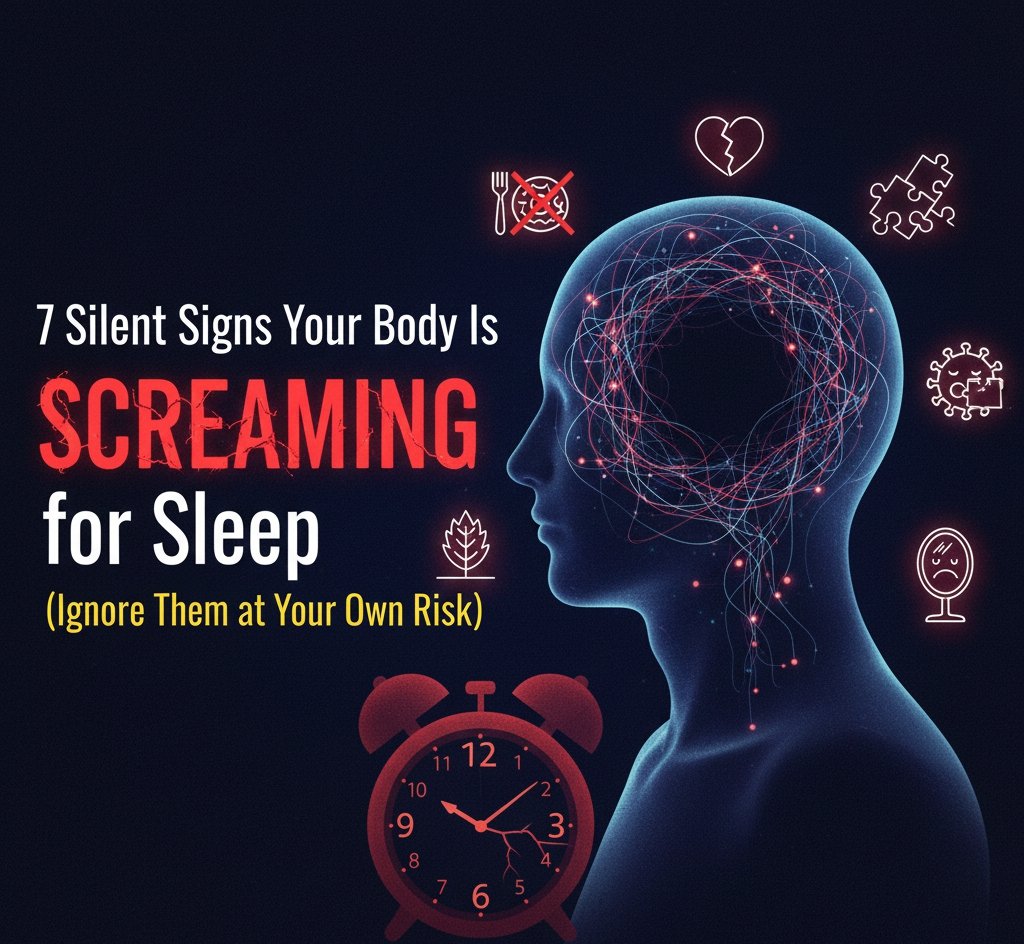
But your body is screaming at you through signals you’re completely missing.
Here’s what’s terrifying: The CDC reports that over one-third of American adults don’t get enough sleep. Even worse? Most don’t realize the catastrophic damage happening inside their bodies until serious health sleep deprivationproblems appear.
Sleep deprivation doesn’t just make you tired. It rewires your brain, sabotages your metabolism, destroys your immune system, and literally shortens your lifespan.
In this article, you’ll discover:
7 shocking signs your body is desperately sleep-deprived (constant yawning isn’t even on the list)
What happens to your brain after just ONE night of poor sleep
The long-term health consequences that could cost you decades of life
Exactly how to fix your sleep before it’s too late
If you’ve been ignoring your body’s desperate pleas for rest, consider this your final wake-up call.
Why This Matters: America’s Hidden Health Crisis
Before we dive into the warning signs, understand the stakes:
The sleep epidemic by the numbers:
35% of Americans sleep less than 7 hours nightly (CDC)
50-70 million Americans suffer from chronic sleep disorders
$411 billion lost annually due to sleep-related productivity loss
6,000+ deaths yearly from drowsy driving alone
Sleep isn’t optional—it’s biological survival.
Dr. Matthew Walker, UC Berkeley neuroscience professor and author of Why We Sleep, calls sleep deprivation “the greatest public health challenge we face in the 21st century.”
The World Health Organization has declared a sleep loss epidemic throughout all industrialized nations.
While you sleep, your body:
Consolidates memories and flushes brain toxins
Repairs damaged tissues and builds muscle
Regulates critical hormones (stress, hunger, sex hormones)
Strengthens immune defenses
Processes emotions and trauma
Skip sleep = skip these life-sustaining processes.
Now let’s explore the hidden signs your body is in crisis mode.
Silent Sign #1: You’re Ravenously Hungry ALL the Time (Especially Craving Junk Food)
Think your cravings are just willpower issues? Wrong.
Sleep deprivation hijacks your hunger hormones and makes you crave the exact foods that destroy your health.
Here’s the brutal science:
Ghrelin (hunger hormone) SURGES by 15-20%:
Screams at your brain that you’re starving
Creates intense, uncontrollable cravings
Stays elevated all day long
Leptin (fullness hormone) PLUMMETS by 15%:
Can’t signal when you’re satisfied
You never feel full
Keep eating without satisfaction
The result? Perpetual hunger + zero satisfaction + intense junk food cravings.
But it gets MUCH worse:
University of Chicago research found sleep-deprived people consumed 300+ extra calories daily—almost entirely from snacks and junk food.
Why junk food specifically?
Sleep loss affects your brain’s reward center (the endocannabinoid system yes, similar to marijuana). UC Berkeley discovered that tired brains show:
Massive activation in reward centers when viewing junk food
Shut down in the impulse control area (frontal lobe)
Intense desire for high-fat, high-sugar foods
Zero ability to resist temptation
Translation: Your tired brain literally gets high off junk food.
The shocking research:
American Journal of Clinical Nutrition study: People sleeping 5.5 hours (vs. 8.5 hours) for just two weeks:
Lost 55% LESS body fat
Lost 60% MORE muscle mass
Had dramatically higher hunger
Craved carbs and sweets constantly
Same calorie intake. Their bodies just couldn’t burn fat without sleep.
What to watch for:
Constant snacking throughout the day
Obsessive cravings for chips, cookies, candy, pizza
Never feeling satisfied after meals
Midnight kitchen raids
“Needing” sugar or caffeine constantly
Weight gain despite “trying to be good”
If you’re battling relentless hunger and cravings, the problem isn’t your willpower—it’s your pillow.
Silent Sign #2: Your Emotions Are a Rollercoaster (Crying, Snapping, or Feeling Numb)
Crying at commercials? Exploding at your partner over nothing? Feeling emotionally dead inside?
Sleep deprivation doesn’t just affect your body—it catastrophically alters your emotional brain.
The neuroscience is terrifying:
UC Berkeley brain imaging studies found:
The amygdala (emotion center) becomes 60% MORE reactive:
Wildly overreacts to negative triggers
Creates extreme emotional responses
Can’t regulate intensity
Produces “emotional hijacking”
The prefrontal cortex (rational brain) goes offline:
Normally keeps emotions balanced
Gets disconnected from amygdala when tired
You completely lose emotional control
Translation: Your emotional gas pedal gets stuck while your brakes fail.
What this looks like in real life:
Rage and irritability:
Tiny annoyances feel like major attacks
Snapping at people you love
Road rage intensifies
Zero patience for anything
Anxiety spirals:
Racing thoughts keeping you awake (vicious cycle)
Catastrophic thinking
Social anxiety explodes
Uncontrollable worry
Depression symptoms:
Crying easily or constantly
Feeling hopeless
Loss of interest in everything
Emotional numbness
The depression connection is bidirectional:
90% of depressed people have sleep problems
Insomnia increases depression risk by 10x
Sleep deprivation triggers identical brain patterns as clinical depression
Fixing sleep often eliminates depression
Even more alarming:
The Journal of Neuroscience found that one night of total sleep deprivation triggers symptoms identical to anxiety disorders.
The Harvard longitudinal study (10,000+ people, decades) discovered: Chronic sleep problems predict depression development years later.
What to watch for:
Crying at unusual triggers
Getting angry instantly
Feeling anxious without clear reason
Wild mood swings
Feeling emotionally “raw”
Can’t bounce back from stress
Loved ones saying “you’re not yourself”
Quick test: If spilled coffee or traffic feels like a catastrophe, you’re sleep-deprived.
Silent Sign #3: You Can’t Remember Anything (Keys, Names, Why You Walked Into Rooms)
Constantly searching for your keys? Forget names instantly? Walk into rooms and have no idea why?
You’re not “getting old” or “naturally forgetful.” Your sleep-deprived brain literally cannot form new memories.
What happens to memory without sleep:
Short-term memory crashes by 40%:
UC Berkeley research showed sleep-deprived people experience up to 40% reduction in memory formation ability.
Dr. Matthew Walker’s studies revealed the hippocampus (memory center) goes “offline” when tired:
Can’t encode new information
Can’t transfer memories to long-term storage
Gets “waterlogged” with unprocessed information
Learning capacity essentially shuts down
One all-nighter = 40% memory loss (equivalent to being legally drunk).
The “why am I in this room?” phenomenon:
This isn’t just annoying—it’s a red flag your working memory is compromised:
Working memory = temporary information storage (like computer RAM)
Sleep deprivation slashes working memory capacity
You forget intentions and thoughts within seconds
Brain can’t hold multiple pieces of information
Long-term memory consolidation stops:
This is the terrifying part: Sleep is when memories become permanent.
During deep sleep your brain:
Replays and strengthens new memories
Transfers information to permanent storage
Clears irrelevant information
Connects new knowledge to old
Skip this process = memories simply vanish.
Studies prove:
All-nighters = 50% less retention than sleeping
Sleeping after learning = 40% better recall
Even 90-minute naps = 30% memory improvement
The dementia connection (CRITICAL):
Recent research discovered a terrifying link between sleep loss and Alzheimer’s:
During deep sleep, your brain activates a “cleaning system” (glymphatic system) that:
Flushes metabolic waste
Specifically clears beta-amyloid (toxic Alzheimer’s protein)
Only works during quality sleep
Requires adequate deep sleep
Matthew Walker’s research: People sleeping under 6 hours have dramatically higher beta-amyloid accumulation—the hallmark of Alzheimer’s.
The Whitehall II study (8,000 people, 25+ years): Sleeping less than 6 hours in your 50s-60s = 30% higher dementia risk later.
Consult a healthcare provider or sleep specialist if you experience:
⚠️ Chronic insomnia (difficulty falling or staying asleep 3+ months)
⚠️ Loud snoring, gasping, or breathing pauses during sleep (possible sleep apnea)
⚠️ Excessive daytime sleepiness despite adequate sleep opportunity
⚠️ Restless legs or uncomfortable sensations preventing sleep
⚠️ Unusual behaviors during sleep (sleepwalking, talking, acting out dreams)
⚠️ Extreme difficulty waking or staying awake
⚠️ Morning headaches or dry mouth upon waking
⚠️ Depression, anxiety, mood changes from poor sleep
⚠️ Falling asleep at dangerous times (driving, eating, talking)
🆘 SEEK EMERGENCY CARE FOR:
• Severe shortness of breath during sleep – CALL 911
• Chest pain with sleep problems – IMMEDIATE CARE
• Sudden extreme fatigue with confusion – GO TO ER
Sleep disorders are treatable medical conditions. Many improve dramatically with proper diagnosis and treatment.
This information does NOT replace professional medical evaluation.
What to watch for:
Constantly misplacing things
Forgetting mid-sentence what you’re saying
Walking into rooms confused
Can’t recall earlier conversations
Difficulty learning anything new
Forgetting appointments without reminders
Rereading sentences multiple times
Can’t remember if you locked the door, turned off the stove
The good news? Unlike age-related decline, sleep-deprivation memory problems are completely reversible. One week of good sleep = dramatic cognitive improvement.
Silent Sign #4: You Catch Every Single Cold, Flu, and Bug That Goes Around
Always sick? The “unlucky” person who catches everything? Take weeks to recover when others bounce back in days?
This isn’t bad luck or “weak immunity”—your sleep deprivation is systematically demolishing your immune system.
The immune-sleep connection is brutal:
One night of poor sleep = measurably destroyed immunity.
UC San Francisco landmark study: People sleeping less than 6 hours were 4.2 TIMES more likely to catch a cold when exposed.
Not 42% more likely. 4.2 TIMES.
What happens to immunity without sleep:
Natural killer cells plummet 70%:
Natural killer (NK) cells are your immune first responders they destroy viruses, bacteria, and cancer cells.
One night of 4-hour sleep = 70% NK cell reduction.
One bad night = 70% immune function GONE.
Vaccination effectiveness collapses:
Sleep-deprived people produce:
50% fewer antibodies after flu shots
Take much longer to develop immunity
May never achieve protective levels
Translation: Even vaccines might not protect you if you’re tired.
Inflammation spirals out of control:
Chronic sleep loss triggers persistent inflammation:
Spikes inflammatory markers (C-reactive protein, IL-6)
Keeps immune system in constant “attack mode”
Exhausts immune resources
Creates vulnerability
This inflammation also:
Accelerates aging
Increases heart disease risk
Promotes diabetes
Fuels cancer growth
Worsens autoimmune diseases
The cancer connection (yes, really):
The WHO classified night shift work as a “probable carcinogen” due to chronic circadian disruption.
Sleeping under 6 hours consistently = dramatically higher cancer risk:
50% higher colorectal cancer risk
Elevated breast cancer rates (women)
Higher prostate cancer risk (men)
Compromised cancer-fighting cells
Dr. Matthew Walker: “The shorter your sleep, the shorter your lifespan.”
What to watch for:
Catching every illness going around
Taking 2-3 weeks to recover (others recover in days)
Frequent throat, ear, sinus infections
Persistent low-grade infections
Cold sores/herpes outbreaks (immune weakness)
Slow wound healing
Frequent mouth ulcers
Getting sick after every stressful period
The vicious cycle:
Sleep deprivation weakens immunity
You get sick
Illness disrupts sleep further
Recovery drags on
More vulnerable to next infection
Repeat endlessly
Breaking this requires prioritizing sleep BEFORE getting sick.
Silent Sign #5: Your Skin Looks Exhausted (Aging Faster Than It Should)
Notice more wrinkles, dark circles, dull skin, breakouts? It’s not stress—it’s sleep deprivation literally aging your face.
“Beauty sleep” isn’t marketing—it’s biology.
What happens to skin without sleep:
Collagen breakdown accelerates:
During deep sleep, your body produces growth hormone (HGH) which:
Stimulates collagen production
Repairs damaged cells
Maintains elasticity
Keeps skin firm
Without sleep:
HGH production crashes
Collagen synthesis stops
Elasticity vanishes
Wrinkles deepen rapidly
Skin thins and weakens
Clinical and Experimental Dermatology found poor sleepers showed:
Increased aging signs
Reduced skin barrier function
Lower appearance satisfaction
Slower recovery from damage
Cortisol (stress hormone) attacks skin:
Sleep deprivation elevates cortisol which:
Directly breaks down collagen
Triggers inflammation
Disrupts skin barrier
Accelerates aging
Worsens acne, eczema, psoriasis
Nightly skin repair stops:
Your skin’s maintenance schedule includes:
Cell turnover (peaks at night)
DNA repair from UV damage
Antioxidant production
Increased blood flow with nutrients
Skip sleep = skip ALL repair processes.
The shocking Estée Lauder study:
Poor sleepers had:
45% more fine lines
11% more dark spots
13% more sagging
72% slower barrier recovery
Participants looked older, less healthy, and less attractive when sleep-deprived.
What to watch for:
Persistent dark circles
New wrinkles or deeper lines
Lost “bounce” in skin
Dull, lifeless complexion
Increased breakouts
Looking “tired” or “drawn”
Puffiness (especially eyes)
Dry, flaky patches
Redness and sensitivity
People asking “are you feeling okay?”
The good news: Skin improvement is one of the fastest visible changes with better sleep:
Brighter complexion: 3-5 days
Reduced dark circles: 1 week
Better texture: 2 weeks
Visible anti-aging: 1 month
Your $200 serum can’t compete with 8 hours of sleep.
Silent Sign #6: You’re Clumsy and Accident-Prone (Bumping, Dropping, Hurting Yourself)
Tripping over nothing? Bumping into door frames? Dropping things constantly? Fender benders or near-misses?
You’re not “just clumsy”—your sleep-deprived brain has lost spatial awareness, coordination, and reaction time.
The research is frightening:
After 17-19 hours awake = 0.05% blood alcohol (legally impaired in many countries)
After 24 hours awake = 0.10% blood alcohol (legally drunk everywhere)
Translation: Being tired makes you as impaired as being drunk—but there’s no breathalyzer for sleep deprivation.
What breaks down in your brain:
Spatial awareness deteriorates:
Can’t judge distances accurately
Depth perception becomes unreliable
Peripheral vision narrows
Misjudge gaps, heights, distances
Motor control becomes erratic:
Fine motor skills decline dramatically
Hand-eye coordination suffers
Timing becomes inconsistent
Movements imprecise
Attention collapses:
“Microsleeps” occur (brief 1-10 second blackouts)
Mind wanders uncontrollably
Miss critical environmental details
Can’t maintain focus
Decision-making slows:
Information processing delays
Slow responses to hazards
Poor risk assessment
Impulsive, careless choices
The deadly consequences:
Drowsy driving KILLS:
National Highway Traffic Safety Administration:
6,000+ deaths annually
100,000+ crashes reported (vastly underreported)
As dangerous as drunk driving
At 60mph, a 4-second microsleep = 352 feet traveled (longer than a football field) COMPLETELY UNCONSCIOUS.
Warning signs you’re too tired to drive:
Difficulty keeping eyes open
Head nodding
Drifting between lanes
Missing exits
Don’t remember last few miles
Frequent yawning
If you experience ANY of these: PULL OVER IMMEDIATELY. A 15-20 minute nap can save your life.
Workplace accidents spike:
13% of workplace injuries due to sleep deprivation
Higher accident rates in tired workers
More severe injuries
Dangerous judgment errors
Chernobyl, Exxon Valdez, and Three Mile Island disasters ALL involved sleep-deprived operators.
What to watch for:
Bumping into furniture, walls, doorframes
Dropping things constantly
Spilling drinks frequently
Tripping or stumbling
Minor cuts, burns, bruises you don’t recall
Breaking things accidentally
Near-misses (almost dropping valuables)
Difficulty with precision tasks
Close calls driving
The terrifying part: Unlike drunk people, sleep-deprived people don’t realize they’re impaired and think they’re “fine.”
Silent Sign #7: Your Sex Drive Has Completely Vanished (And You Don’t Even Care)
Zero interest in sex? Too exhausted to even think about intimacy? Feel disconnected from your partner?
Low libido is one of the most common—and most ignored—signs of sleep deprivation.
Why sleep loss destroys sex drive:
Testosterone plummets (ALL genders):
University of Chicago: Young, healthy men sleeping 5 hours nightly for one week experienced:
10-15% testosterone drop
Equivalent to aging 10-15 years
After just ONE WEEK
For women:
Testosterone (critical for female libido too) drops
Estrogen balance disrupts
Affects arousal, desire, satisfaction
Other hormones collapse:
Growth hormone declines:
Released during deep sleep
Critical for energy
Without it, exhaustion dominates
Cortisol (stress hormone) spikes:
Chronically elevated when tired
Directly suppresses sex hormones
Body enters “survival mode” not “reproduction mode”
Energy evaporates:
Too exhausted to initiate or respond
Physical fatigue overwhelming
Mental exhaustion prevents arousal
“Just want to sleep” becomes default
Emotional connection suffers:
Irritability creates relationship friction
Less patience with partner
Reduced emotional availability
Intimacy feels like “another chore”
Resentment builds
The research is clear:
Journal of Sexual Medicine study:
Each extra sleep hour = 14% increased sexual desire
Women sleeping longer significantly more likely to have sex next day
Sleep quality predicted sexual satisfaction better than relationship duration
Men with sleep apnea had dramatically lower testosterone and higher ED rates—both improved with sleep treatment.
What to watch for:
Complete lack of interest (when you used to enjoy sex)
Too exhausted to initiate or respond
Avoiding physical intimacy
Partner expressing concern
Feeling disconnected from sexuality
Erectile dysfunction or arousal difficulties
No morning erections (men hormonal sign)
Preferring sleep over intimacy always
Sex feels like “obligation”
Relationship tension over intimacy
The surprising recovery:
Libido bounces back quickly with improved sleep:
Increased desire within 1-2 weeks
Testosterone normalizes
Energy returns
Emotional connection improves
Physical function enhances
Couples who prioritized sleep reported:
30% better sexual satisfaction
More frequent intimacy
Better relationship quality
Less conflict
If your sex drive vanished, don’t blame your relationship, age, or attraction check your sleep first.
thoughts are #1 insomnia cause
Try journaling before bed
Practice meditation
Consider therapy for underlying anxiety
When to see a doctor:
Insomnia lasting 3+ months
Significantly impacting daily life
Despite trying behavioral changes
CBT-I (delivered by trained therapist) is gold-standard treatment
Avoid: Relying on sleep medications long-term without addressing root causes.
Q6: Can certain foods help me sleep better?
A: Some foods contain sleep-promoting compounds, but don’t expect miracles.
Foods with sleep support:
Tryptophan-rich foods:
Turkey, chicken, eggs
Helps produce serotonin and melatonin
Eat with carbs for best absorption
Magnesium-rich foods:
Almonds, spinach, pumpkin seeds
Promotes muscle relaxation
Many people deficient
Complex carbohydrates:
Oatmeal, whole grain toast
Small serving before bed can help
Increases tryptophan availability
Tart cherry juice:
Natural melatonin source
Some research shows modest improvements
8 oz, 1-2 hours before bed
Chamomile tea:
Mild sedative properties
Traditional sleep aid
Caffeine-free, calming
Foods to AVOID before bed:
Heavy, fatty meals (digestion disrupts sleep)
Spicy foods (can cause reflux, discomfort)
High sugar (blood sugar spikes and crashes)
Large amounts of liquid (midnight bathroom trips)
Bottom line: Foods can support sleep hygiene but won’t overcome major sleep issues. Focus on overall sleep habits first.
Q7: Is sleep apnea really that serious?
A: YES. Sleep apnea is extremely serious and often undiagnosed.
What it is:
Repeated breathing pauses during sleep (airway collapses), causing:
Oxygen deprivation
Fragmented sleep
Strain on cardiovascular system
Warning signs:
Loud snoring
Gasping or choking during sleep
Morning headaches
Extreme daytime fatigue
Dry mouth upon waking
Partner reports breathing pauses
Health consequences (if untreated):
3x higher heart attack risk
4x higher stroke risk
Significantly increased diabetes risk
High blood pressure
Weight gain
Cognitive decline
Depression
The good news: Highly treatable with:
CPAP machine (most common)
Oral appliances
Weight loss (if overweight)
Positional therapy
Surgery (severe cases)
If you suspect sleep apnea, see a sleep specialist immediately. This is not something to ignore.
Q8: How long does it take to “fix” my sleep?
A: Depends on how chronic your sleep debt is.
Short-term sleep deprivation (days to weeks):
Improvements visible in 3-7 days
Mood stabilizes
Energy returns
Cognitive function improves
Hunger normalizes
Chronic sleep deprivation (months to years):
2-4 weeks for significant improvements
Hormone regulation takes time
Circadian rhythm needs retraining
Sleep architecture needs rebuilding
Full recovery can take months
What to expect:
Week 1:
May feel worse initially (sleep debt catching up)
Might sleep 9-10 hours as body recovers
Don’t panic—this is normal
Weeks 2-4:
Energy levels stabilize
Mood improves noticeably
Cognitive function sharpens
Start waking naturally
Cravings reduce
Months 2-3:
Sleep architecture normalizes
Hormones rebalance
Immune function strengthens
Full benefits realized
Be patient: Your body needs time to heal from chronic sleep deprivation.
Q9: What’s the single most important thing I can do tonight?
A: Go to bed 30 minutes earlier than usual.
Seriously. That’s it.
Not supplements, not gadgets, not sleep tracking. Just get in bed earlier.
Why this works:
Most people are chronically under-sleeping
Adding 30 minutes = significant improvement
Simple, free, immediate
Compounds over time (3.5 extra hours weekly)
Tonight’s action plan:
Set a bedtime alarm for 30 minutes earlier
Start wind-down routine when alarm goes off
Turn off screens
Get in bed
Repeat tomorrow
After 1 week, you’ll notice dramatic improvements.
Then add other strategies from this article one at a time.
Don’t overcomplicate it. Just sleep more.
Q10: My partner snores/moves/disrupts my sleep. What do I do?
A: This is a common and solvable problem.
For snoring:
Immediate solutions:
Earplugs (foam, silicone, or custom)
White noise machine or app
Fan for ambient noise
Separate bedrooms (not a relationship failure—a health necessity)
Long-term solutions:
Partner sees doctor (snoring often indicates sleep apnea)
Positional therapy (sleep on side, not back)
Weight loss if overweight
Avoid alcohol before bed
Treat allergies/nasal congestion
For movement (restless partner):
Separate blankets (reduces disturbance)
Larger bed (king vs queen makes huge difference)
Mattress with motion isolation (memory foam, latex)
Body pillow barrier
Separate beds or bedrooms if needed
For different sleep schedules:
Partner uses dim red light (doesn’t suppress melatonin)
Earplugs and eye mask for early sleeper
Late partner very quiet entering room
Consider sleeping separately on work nights, together on weekends
Important: Separate sleeping arrangements don’t mean relationship problems. They mean prioritizing both partners’ health. Many happy couples sleep separately.
Talk openly: Discuss solutions without blame. Frame it as “we both need good sleep” not “you’re keeping me awake.”
Conclusion: Your Body Has Been Warning You—Will You Finally Listen?
You’ve now seen the seven silent signs your body uses to scream for sleep:
Constant hunger and junk food cravings (hormonal hijacking)
Emotional rollercoaster (brain chemistry chaos)
Memory failure (cognitive shutdown)
Getting sick constantly (immune collapse)
Aging skin (repair systems offline)
Clumsiness and accidents (dangerous impairment)
Vanished sex drive (hormonal devastation)
Each of these isn’t just annoying—it’s your body’s desperate cry for help.
The stakes couldn’t be higher:
Every night of poor sleep damages your brain
Sleep deprivation increases risk of every major disease
Chronic sleep loss literally shortens your lifespan
The damage accumulates silently for years before serious illness appears
But here’s the empowering truth: Unlike many health issues, sleep is almost entirely within your control.
You don’t need expensive treatments, dangerous medications, or extreme interventions.
You just need to prioritize it.
Your action plan starting TONIGHT:
Step 1: Choose ONE strategy from this article
Go to bed 30 minutes earlier
Make your room completely dark
Cut screens 1 hour before bed
Stop caffeine after 2 PM
Create a consistent sleep schedule
Step 2: Commit to 2 weeks
Track how you feel daily
Notice improvements
Don’t give up after 2-3 days
Your body needs time to adjust
Step 3: Add another strategy
Layer improvements gradually
Build a sustainable sleep routine
Make it non-negotiable
Protect your sleep like your life depends on it (it does)
The bottom line:
Sleep isn’t a luxury you’ll get to “someday when life calms down.”
Life will never calm down unless you make it.
Your body has been warning you through hunger, emotions, memory, illness, aging, accidents, and lost intimacy.
The question is simple: Will you finally listen?
Or will you ignore these warnings until a serious health crisis forces you to pay attention?
The choice is yours.
Make tonight the night you finally prioritize the one thing that affects literally everything else in your life.
Your brain, body, relationships, career, and future self will thank you.
📚 Sources & References
This article was researched using credible medical and scientific sources:
- Walker, Matthew PhD – “Why We Sleep: Unlocking the Power of Sleep and Dreams” (2017)
- Centers for Disease Control and Prevention (CDC) – “Sleep and Sleep Disorders” – https://www.cdc.gov/sleep/
- National Heart, Lung, and Blood Institute – “Sleep Deprivation and Deficiency” – https://www.nhlbi.nih.gov/health/sleep-deprivation
- Harvard Medical School – Division of Sleep Medicine – http://healthysleep.med.harvard.edu/
- American Academy of Sleep Medicine – “Sleep Education” – https://sleepeducation.org/
- Mayo Clinic – “Sleep Disorders” – https://www.mayoclinic.org/diseases-conditions/sleep-disorders/
- National Sleep Foundation – “Sleep Health Topics” – https://www.thensf.org/
- Journal of Clinical Sleep Medicine – Multiple peer-reviewed studies on sleep deprivation effects
- The Lancet – Research on sleep and mortality – https://www.thelancet.com/
- Nature Reviews Neuroscience – Studies on sleep and brain function
- American Psychological Association – “Why Sleep Is Important” – https://www.apa.org/topics/sleep
- World Health Organization – “Sleep and Health” resources
- UC Berkeley Sleep and Neuroimaging Laboratory – Matthew Walker’s research
- University of Chicago Sleep Research Laboratory – Studies on sleep and metabolism
- UCSF Weill Institute for Neurosciences – Sleep and immunity research
Last Reviewed: December 18, 2024
Next Review: March 18, 2025
All information is for educational purposes only. This content has been researched using credible medical and scientific sources but does not constitute medical advice. Always consult your healthcare provider for medical guidance.
