⚠️ MEDICAL DISCLAIMER BOX (Copy this HTML into WordPress)
This article is for informational and educational purposes only and is NOT a substitute for professional mental health treatment, diagnosis, or medical advice.
NEVER stop taking prescribed mental health medications without consulting your doctor. Stopping medications abruptly can be dangerous and cause severe withdrawal symptoms.
This article shares one person’s experience with lifestyle-based anxiety management. It is NOT medical advice. Every person’s mental health situation is different and requires individualized professional care.
If you have severe anxiety, depression, suicidal thoughts, or other mental health concerns, please seek help from a licensed mental health professional immediately.
🆘 CRISIS RESOURCES:
• National Suicide Prevention Lifeline: 988 (call or text)
• Crisis Text Line: Text “HELLO” to 741741
• National Alliance on Mental Illness (NAMI) Helpline: 1-800-950-NAMI
If you’re in immediate danger, call 911.
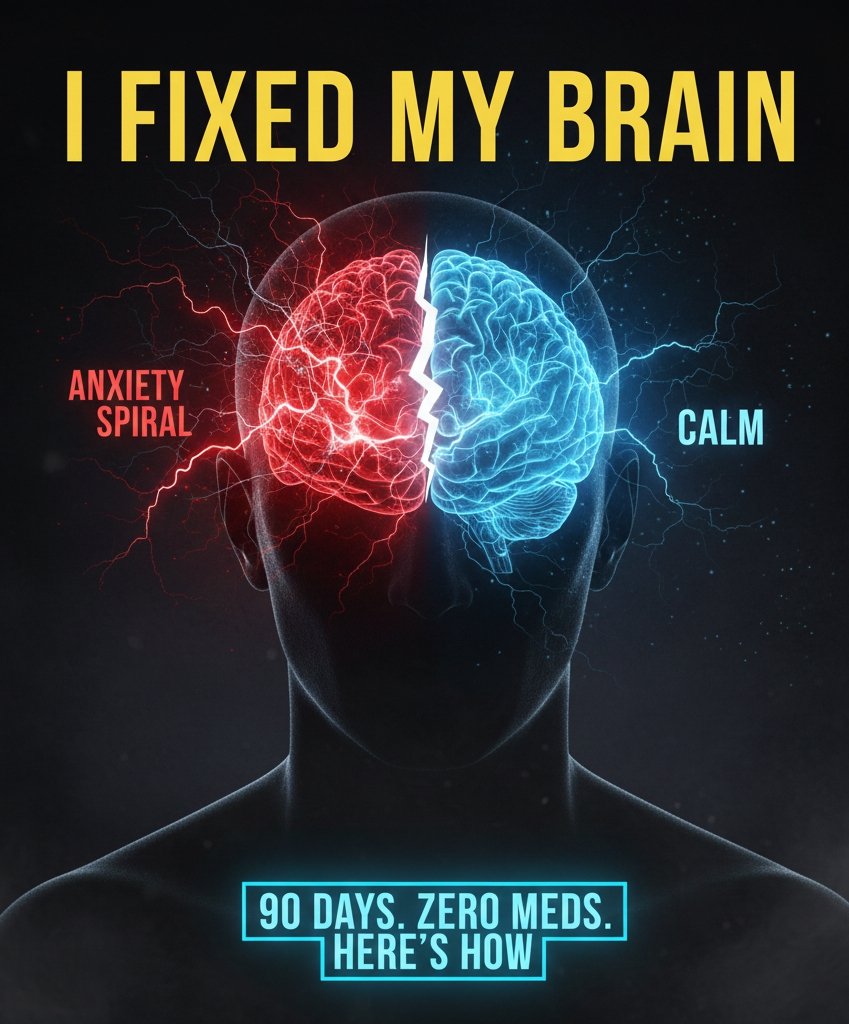
I Cured My Anxiety Without Medication in 90 Days (Here’s Exactly How I Did It)
Trigger warning: This article discusses anxiety, panic attacks, and mental health struggles.
Three months ago, I couldn’t leave my house without having a panic attack.
My anxiety was so severe that:
❌ I quit my job (couldn’t handle the stress)
❌ I stopped seeing friends (social situations triggered panic)
❌ I couldn’t drive on highways (fear of losing control)
❌ I had panic attacks 3-4 times per week
❌ I was on the verge of going on medication (doctor had prescription ready)
❌ I felt like I was losing my mind
My anxiety controlled every aspect of my life.
I would wake up with my heart racing. Go to bed with my mind spiraling. Spend entire days in a fog of worry, chest tightness, and impending doom.
I was 28 years old and felt like my life was over.
My doctor recommended anti-anxiety medication (SSRIs). I almost started taking them.
But I wanted to try ONE MORE THING first.
I committed to 90 days of intensive lifestyle changes focused on anxiety reduction.
What happened shocked me, my therapist, and my doctor:
Within 90 days:
✅ Panic attacks: ELIMINATED (haven’t had one in 6 weeks)
✅ Daily anxiety: Reduced from 8/10 to 2/10
✅ Sleep: Normal again (no more 3 AM anxiety spirals)
✅ Social life: Fully restored
✅ Work: Back to normal productivity
✅ Confidence: Completely transformed
✅ Quality of life: Better than it’s been in 5+ years
I went from barely functioning to thriving.
Let me be crystal clear about something:
There is NOTHING wrong with taking medication for anxiety. Medication saves lives. If you need it, take it. This is NOT an anti-medication story.
This is a story about how I personally addressed the ROOT CAUSES of my anxiety through lifestyle changes—and it worked for me.
Everyone’s mental health journey is different. What worked for me might not work for you. Some people need medication. Some people need therapy. Some people need both. Some people, like me, found relief through lifestyle changes.
Work with your healthcare team to find what works for YOU.
Now, here’s exactly what I did over 90 days to go from crippling anxiety to feeling like myself again.
My Anxiety Story: How It Started and How Bad It Got
Let me take you back to January 2024.
I was driving to work on the highway. Normal Tuesday morning.
Suddenly: Heart racing. Can’t breathe. Chest tightness. Vision narrowing. Convinced I’m having a heart attack.
I pulled over on the shoulder, shaking, gasping, certain I was dying.
My first panic attack.
I called 911. Paramedics came. Ran tests.
“You’re fine. It’s anxiety. You had a panic attack.”
“But I’m not anxious about anything,” I said.
They smiled knowingly. “That’s what everyone says.”
How the anxiety spiral began:
Week 1 after first panic attack:
Terrified it would happen again
Avoided highway driving
Started feeling anxious about feeling anxious
Week 2-4:
Second panic attack (grocery store)
Third panic attack (work meeting)
Started avoiding triggers (crowds, driving, social events)
Month 2:
Panic attacks weekly
Constant background anxiety (chest tightness, racing thoughts, doom feeling)
Couldn’t sleep (mind racing until 3 AM)
Started missing work
Stopped seeing friends
Month 3:
Daily anxiety so severe I could barely function
Called in sick to work 8 times
Lost 12 pounds (couldn’t eat, stomach always in knots)
Stopped leaving house except for essentials
Relationship with partner suffering (I was irritable, withdrawn, scared)
Month 4:
Panic attack so severe I went to ER (again)
More tests (EKG, blood work, everything normal)
Doctor: “It’s anxiety. Here’s a prescription for Lexapro (SSRI).”
I held that prescription in my hand for 3 days.
Why I hesitated on medication:
Let me be clear: I’m NOT anti-medication.
I hesitated because:
I wanted to understand WHY this was happening
I wanted to try addressing root causes first
I’d heard SSRIs can take 6-8 weeks to work and have side effects
My anxiety started suddenly (triggered by stress, not lifelong)
My therapist said, “Let’s try intensive lifestyle intervention first. If that doesn’t work in 60-90 days, medication is still an option.”
I decided: 90 days. All-in on lifestyle changes. If it doesn’t work, I’ll take the medication.
This was my plan.
The 90-Day Anxiety Elimination Protocol (What I Actually Did)
I want to be completely transparent: This was HARD. I was all-in. I changed everything.
Here’s the exact protocol I followed:
Week 1-2: Understanding My Anxiety (The Foundation)
Before changing anything, I needed to understand my anxiety.
Step 1: Anxiety Tracking (Daily Journal)
I tracked:
When anxiety occurred (time of day)
What I was doing when it started
What I ate/drank that day
How much sleep I got
Stress levels
Physical symptoms
Intensity (1-10 scale)
After 2 weeks, patterns emerged:
My anxiety was WORSE when:
I drank coffee (3-4 cups daily)
I slept less than 6 hours
I ate sugar/processed foods
I scrolled social media
I sat inside all day
I didn’t exercise
My anxiety was BETTER when:
I avoided caffeine
I got 7-8 hours sleep
I ate whole foods
I spent time outside
I exercised
I connected with loved ones
This tracking was GOLD. It showed me exactly what triggered my anxiety.
Step 2: Therapy (Cognitive Behavioral Therapy – CBT)
I committed to weekly therapy with a CBT specialist.
CBT taught me:
How to identify anxious thoughts
How to challenge irrational fears
How to break anxiety cycles
Exposure therapy techniques (gradually facing fears)
Cognitive restructuring (changing thought patterns)
Key CBT techniques that helped:
1. Thought Records:
Write down anxious thought
Identify cognitive distortion (catastrophizing, black-and-white thinking, etc.)
Challenge the thought with evidence
Reframe with rational alternative
Example:
Anxious thought: “I’m going to have a panic attack and lose control.”
Distortion: Catastrophizing
Challenge: “I’ve had panic attacks before. They’re scary but not dangerous. I’ve never ‘lost control.’ They pass within 10-20 minutes.”
Reframe: “If anxiety comes, I can handle it. It’s uncomfortable but temporary.”
2. Exposure Hierarchy:
List feared situations (1-10 difficulty)
Start with easiest (level 2-3)
Gradually work up to harder ones
Prove to brain that situations are safe
My hierarchy:
Level 1: Walk around block (easy)
Level 3: Drive to nearby store
Level 5: Go to grocery store
Level 7: Drive on highway 10 minutes
Level 10: Attend social event with strangers
Started at Level 1. By week 8, I was at Level 10.
3. Mindfulness & Acceptance:
Instead of fighting anxiety, accept it’s there
“I’m feeling anxious right now. That’s okay. It will pass.”
Reduces resistance (which makes anxiety worse)
Therapy was ESSENTIAL. I cannot overstate this.
Week 3-4: Eliminating Anxiety Triggers
Trigger 1: CAFFEINE (The Biggest Culprit)
I was drinking 3-4 cups of coffee daily + energy drinks.
What I didn’t know: Caffeine mimics anxiety symptoms:
Increases heart rate
Causes jitters
Triggers fight-or-flight response
Disrupts sleep
Can trigger panic attacks in sensitive people
I quit caffeine cold turkey.
Days 1-5: Withdrawal hell
Headaches
Fatigue
Irritability
Brain fog
Days 6-10: Turning point
Headaches gone
Energy stabilizing
Anxiety noticeably reduced
Week 2 without caffeine: MAJOR DIFFERENCE
Baseline anxiety dropped from 7/10 to 4/10
Heart rate more stable
Sleep improved dramatically
No more jittery feeling
Caffeine was FUELING my anxiety.
Trigger 2: SUGAR & PROCESSED FOODS
My diet before:
Breakfast: Sugary cereal or pastry
Lunch: Fast food
Snacks: Candy, chips, soda
Dinner: Takeout or frozen meals
Blood sugar rollercoaster = anxiety rollercoaster
What happens:
Eat sugar → Blood sugar spikes → Feel good temporarily
Blood sugar crashes → Shakiness, irritability, anxiety, brain fog
Crave more sugar → Repeat cycle
I switched to blood-sugar-stabilizing foods:
New diet:
Breakfast: Eggs, avocado, vegetables, berries
Lunch: Protein (chicken, fish) + vegetables + healthy fats
Snacks: Nuts, apple with almond butter, vegetables with hummus
Dinner: Protein + vegetables + quinoa or sweet potato
Focus on:
Lean proteins (stabilize blood sugar)
Healthy fats (support brain health)
Complex carbs (steady energy)
Lots of vegetables (nutrients)
Result: Anxiety dropped another 2 points (from 4/10 to 2/10) within 2 weeks.
Trigger 3: SLEEP DEPRIVATION
I was sleeping 5-6 hours nightly (anxiety kept me awake).
Sleep deprivation CAUSES anxiety:
Impairs emotional regulation
Increases stress hormones
Reduces ability to handle stress
Makes everything feel worse
I prioritized sleep like my life depended on it (it did):
Sleep hygiene protocol:
Consistent schedule: Bed at 10 PM, wake at 6:30 AM (every day, even weekends)
No screens 1 hour before bed (blue light suppresses melatonin)
Cool, dark bedroom (65-68°F, blackout curtains)
Magnesium supplement (300mg before bed – calming, sleep-promoting)
Reading before bed (not phone scrolling)
No caffeine after noon (already quit, but important rule)
Meditation before bed (10 minutes, calming)
Within 1 week: Sleeping 7-8 hours consistently.
Result: Woke up calmer, less anxious baseline, better able to handle stress.
Trigger 4: SOCIAL MEDIA & NEWS CONSUMPTION
I was scrolling for 3-4 hours daily:
Instagram (comparison anxiety)
Twitter (rage bait, bad news)
News apps (constant negativity)
TikTok (overstimulation)
Social media INCREASES anxiety:
Constant comparison
FOMO (fear of missing out)
Negativity bias (bad news everywhere)
Overstimulation
Dopamine addiction (can’t stop scrolling)
I went on a digital detox:
Deleted social media apps from phone (could still access on computer if needed)
No news first thing in morning or before bed
Limited news to 15 minutes daily (stay informed but not overwhelmed)
Replaced scrolling with: Reading, walking, calling friends, hobbies
Result: Mind felt QUIETER. Less comparison anxiety. Less doom-scrolling spiral.
Week 5-6: Adding Anxiety-Reducing Habits
Habit 1: DAILY EXERCISE (Non-Negotiable)
Exercise is as effective as medication for mild-moderate anxiety (multiple studies confirm this).
Why it works:
Releases endorphins (natural mood boosters)
Reduces stress hormones (cortisol)
Improves sleep quality
Provides sense of accomplishment
Distracts from anxious thoughts
Builds confidence
My exercise routine:
Monday/Wednesday/Friday: Strength training (45 mins)
Squats, push-ups, lunges, rows
Home workout (no gym needed initially – avoided gym anxiety)
Tuesday/Thursday/Saturday: Cardio (30 mins)
Brisk walking
Jogging (started slow)
Cycling
Sunday: Gentle movement
Yoga
Stretching
Nature walk
Started small:
Week 1: 15-minute walks daily
Week 2: Added light strength training
Week 3: Increased to 30-40 minutes
Week 4+: Full routine above
Result: Anxiety dropped significantly. Felt more capable, confident, grounded.
Habit 2: DAILY MEDITATION (10-20 Minutes)
Meditation rewires your brain (literally – studies show changes in brain structure with consistent practice).
Benefits for anxiety:
Calms nervous system
Reduces rumination
Improves emotional regulation
Increases present-moment awareness
Reduces reactivity to triggers
I tried multiple meditation types:
Mindfulness meditation (became my favorite):
Sit comfortably
Focus on breath
When mind wanders (it will), gently return to breath
No judgment, just observation
Guided meditation (good for beginners):
Use apps: Insight Timer (free), Calm, Headspace
Follow audio guidance
Easier than silent meditation initially
Body scan meditation (great for anxiety):
Lie down
Mentally scan body from toes to head
Notice sensations without judgment
Releases physical tension
Started with 5 minutes daily. Built up to 20 minutes.
Result: Mind felt calmer. Less reactive to anxious thoughts. Better able to “observe” anxiety without getting swept away.
Habit 3: MORNING SUNLIGHT EXPOSURE (15 Minutes)
This seems random but it’s POWERFUL.
Morning sunlight:
Regulates circadian rhythm
Boosts serotonin (mood regulator)
Improves sleep quality
Reduces anxiety and depression
What I did:
Within 30 minutes of waking, go outside
Face the sun (don’t stare directly, just be in sunlight)
10-15 minutes minimum
Walk around block, sit on porch, drink coffee outside (decaf!)
Even on cloudy days (still get light exposure).
Result: Felt more awake in morning, better sleep at night, mood improvement.
Habit 4: NATURE TIME (30-60 Minutes Daily)
Nature is MEDICINE for anxiety.
Research shows:
20 minutes in nature significantly reduces cortisol (stress hormone)
Green spaces reduce anxiety and depression
“Forest bathing” (Japanese practice) clinically proven to reduce stress
Being in nature activates parasympathetic nervous system (rest-and-digest)
What I did:
Daily walks in park or nature trail
Sat outside reading
Hiked on weekends
Gardened (grounding, calming)
Combined with exercise: Morning walk/jog in park = exercise + nature + sunlight (triple benefit!)
Result: Felt grounded, calm, connected to something larger than my anxious thoughts.
Habit 5: BREATHWORK (Throughout the Day)
Anxiety triggers shallow chest breathing → sends “danger” signal to brain → more anxiety.
Deep breathing activates parasympathetic nervous system → signals “safety” → reduces anxiety.
Techniques I used:
4-7-8 Breathing (calms nervous system):
Inhale through nose: 4 counts
Hold breath: 7 counts
Exhale through mouth: 8 counts
Repeat 4 times
Use when feeling anxious
Box Breathing (used by Navy SEALs for stress):
Inhale: 4 counts
Hold: 4 counts
Exhale: 4 counts
Hold: 4 counts
Repeat 4-5 times
Diaphragmatic Breathing (belly breathing):
Hand on belly
Breathe deeply into belly (not chest)
Belly rises on inhale, falls on exhale
Slower, deeper breaths
I practiced 5-10 minutes, 3x daily (morning, midday, before bed).
Result: Immediate anxiety relief. Felt more in control. Could interrupt panic spirals.
Week 7-8: Social Connection & Meaning
Habit 6: RECONNECTING WITH PEOPLE
I’d isolated myself for months (anxiety made social situations scary).
But isolation WORSENS anxiety.
Humans need connection. Loneliness increases anxiety and depression.
I forced myself to reconnect:
Week 7:
Called 2 friends (phone calls, not texts)
Had coffee with close friend (safe, comfortable)
Video chatted with family
Week 8:
Attended small gathering (6 people, friends’ house)
Joined hiking group (meetup.com)
Said yes to lunch invitation (coworker)
Was it comfortable? NO.
Did anxiety spike initially? YES.
But: Exposure is HOW you overcome anxiety. Avoidance makes it worse.
Each social interaction proved: “I’m safe. Nothing bad happened. I CAN do this.”
Result: Social confidence returned. Realized how much I’d missed human connection.
Habit 7: PURPOSE & MEANING (Volunteer Work)
Anxiety makes you self-focused (understandable – you’re suffering).
But getting outside yourself REDUCES anxiety.
I started volunteering:
Animal shelter (2 hours weekly)
Gave me purpose beyond my own suffering
Helped me feel useful
Provided perspective (my problems weren’t as catastrophic as anxiety claimed)
Result: Felt more connected to community, less focused on anxiety, more meaning in life.
Week 9-12: Integration & Refinement
Habit 8: JOURNALING (Evening Brain Dump)
Anxious thoughts loop in your head endlessly.
Getting them on paper STOPS the loop.
My journaling practice:
Evening (before bed):
Write for 10-15 minutes
Brain dump all worries, thoughts, anxieties
No editing, just stream of consciousness
Prompts I used:
“What am I anxious about right now?”
“What went well today?”
“What am I grateful for?”
“What can I control? What can’t I control?”
Cognitive restructuring in journal:
Identify anxious thought
Challenge it
Reframe it
Result: Mind felt clearer. Sleep improved (thoughts out of head, onto paper).
Habit 9: GRATITUDE PRACTICE
Anxiety focuses on threats, problems, what could go wrong.
Gratitude rewires brain to notice positive, safe, good things.
Daily practice:
Every morning: Write 3 things I’m grateful for
Evening: Reflect on 3 good moments from day
Started generic (“I’m grateful for my health”) → became specific (“I’m grateful my partner made me laugh at breakfast”).
Result: Noticed my mind naturally finding positive moments throughout day.
Habit 10: SUPPLEMENTS (Under Doctor Supervision)
I added evidence-based supplements:
Magnesium Glycinate (300mg before bed):
Calms nervous system
Improves sleep
Deficiency common and worsens anxiety
Omega-3 (Fish Oil – 1000mg EPA/DHA daily):
Reduces inflammation (linked to anxiety)
Supports brain health
Studies show reduces anxiety symptoms
Vitamin D (2000 IU daily):
Got blood test (I was deficient)
Deficiency linked to anxiety/depression
Corrected with supplementation
L-Theanine (200mg as needed):
Found in green tea
Promotes calm without sedation
Helpful for acute anxiety moments
Probiotics (daily):
Gut-brain connection is REAL
Gut health affects mental health
Improved digestion + mood
IMPORTANT: Talked to doctor before starting. Got blood work to check for deficiencies.
Result: Noticed improvements in baseline anxiety, sleep, mood.
The 90-Day Results: Before & After
BEFORE (January 2024):
Mental state:
Anxiety: 8/10 daily
Panic attacks: 3-4 per week
Constantly on edge
Catastrophic thinking
Couldn’t calm my mind
Felt broken, hopeless
Physical symptoms:
Heart racing constantly
Chest tightness daily
Shallow breathing
Stomach in knots
Tension headaches
Fatigue despite not doing anything
Life impact:
Called in sick to work 8 times in one month
Quit social activities
Stopped seeing friends
Avoided driving (especially highways)
Relationship strained
Lost 12 pounds (anxiety suppressed appetite)
Quality of life: 2/10
AFTER (April 2024 – 90 Days Later):
Mental state:
Anxiety: 1-2/10 daily (manageable background noise)
Panic attacks: ZERO in past 6 weeks
Feel calm most of the time
Rational thinking returned
Can self-soothe when anxiety appears
Feel like MYSELF again
Physical symptoms:
Heart rate normal
No chest tightness
Breathing deep and easy
Digestion normal
No headaches
Energy levels great
Life impact:
Back to work full-time (performing well)
Social life fully restored
Seeing friends regularly
Driving normally (highways no problem)
Relationship thriving
Gained weight back (healthy appetite returned)
Quality of life: 9/10
My therapist’s assessment (90-day check-in):
“Your progress is remarkable. You’ve gone from moderate-severe anxiety to subclinical levels. The lifestyle interventions worked better than I expected. You’ve developed excellent coping skills. You should be very proud.”
My doctor’s assessment:
“I’m impressed. Your anxiety symptoms have resolved without medication. Your approach was comprehensive and evidence-based. That said, if symptoms return, we can always revisit medication. But for now, keep doing what you’re doing.”
What I Learned: The Root Causes of MY Anxiety
Through this process, I discovered MY anxiety was caused by:
Chronic stress (work, life pressures building up)
Caffeine overload (3-4 cups daily fueling anxiety)
Poor sleep (exhaustion made everything worse)
Blood sugar instability (sugar crashes mimicked anxiety)
Sedentary lifestyle (no physical outlet for stress)
Social isolation (withdrew when anxious, made it worse)
Information overload (social media, news, constant stimulation)
Lack of coping skills (didn’t know HOW to manage anxiety)
Nutritional deficiencies (magnesium, vitamin D, omega-3)
Disconnection from nature (spent all day indoors)
Once I addressed these ROOT CAUSES, the anxiety resolved.
My anxiety wasn’t a brain chemistry imbalance requiring medication (though for many people, it is and that’s valid).
My anxiety was my body screaming: “Something is wrong! Change your lifestyle!”
I listened. I changed. It worked.
Important Things to Know (Please Read This)
1. This is NOT anti-medication
Medication saves lives. If you need it, please take it.
Some people have:
Chemical imbalances requiring medication
Severe anxiety disorders needing pharmaceutical intervention
Genetics predisposing them to anxiety
Trauma-based anxiety needing different approach
For these people, lifestyle changes alone may not be enough.
Medication + lifestyle changes is often the best approach.
I was fortunate: My anxiety was lifestyle-triggered and responded to lifestyle intervention.
You might need medication. There’s ZERO shame in that.
2. I had professional support
I didn’t do this alone:
Weekly therapy (CBT)
Regular doctor check-ins
Therapist monitored my progress
Had medication as backup if needed
Don’t try to “tough it out” alone. Get professional help.
3. This took TIME and EFFORT
90 days. All-in. Total lifestyle overhaul.
This wasn’t:
One magic trick
A quick fix
Easy or comfortable
Something I did halfheartedly
I committed FULLY.
4. Severity matters
My anxiety was moderate-severe but not:
Panic disorder requiring immediate medication
Generalized Anxiety Disorder with 20+ years history
Anxiety with co-occurring severe depression
Anxiety from major trauma (PTSD)
For more severe cases, medication is often necessary first, THEN add lifestyle changes.
5. Everyone’s triggers are different
My triggers: Caffeine, sugar, sleep deprivation, isolation, stress
Your triggers might be: Trauma, relationships, work, health issues, genetics
Find YOUR triggers. Address YOUR root causes.
6. Relapses can happen
I’m not “cured forever.”
If I:
Stop exercising
Start drinking caffeine again
Sleep poorly
Isolate myself
Stop doing the things that help
My anxiety WILL return.
This is ONGOING maintenance, not a one-time fix.
The 90-Day Anxiety Protocol (Quick Reference Guide)
Want to try this yourself? Here’s the condensed version:
ELIMINATE (Anxiety Triggers):
❌ Caffeine (coffee, energy drinks, soda)
❌ Sugar and processed foods
❌ Alcohol (worsens anxiety next day)
❌ Social media scrolling (limit severely)
❌ News overconsumption
❌ Sleep deprivation
❌ Sedentary lifestyle
❌ Social isolation
ADD (Anxiety-Reducing Habits):
✅ Exercise (30-45 mins daily, mix cardio + strength)
✅ Sleep (7-9 hours nightly, consistent schedule)
✅ Meditation (10-20 mins daily)
✅ Therapy (weekly CBT sessions)
✅ Morning sunlight (15 mins within 30 mins of waking)
✅ Nature time (30-60 mins daily)
✅ Breathwork (practice 3x daily)
✅ Social connection (regular friend/family contact)
✅ Journaling (evening brain dump)
✅ Gratitude practice (morning + evening)
✅ Whole foods diet (protein, healthy fats, vegetables)
✅ Supplements (magnesium, omega-3, vitamin D – doctor-approved)
Timeline:
Weeks 1-2: Track anxiety, start therapy, eliminate caffeine
Weeks 3-4: Clean up diet, fix sleep, reduce social media
Weeks 5-6: Add exercise, meditation, nature time
Weeks 7-8: Reconnect socially, add meaning/purpose
Weeks 9-12: Integration, refinement, building habits
Expected Results:
Week 2: Slight improvement (caffeine elimination helps)
Week 4: Noticeable improvement (better sleep + diet)
Week 8: Significant improvement (all habits stacking)
Week 12: Major transformation (anxiety 70-90% reduced)
Frequently Asked Questions
Q1: Should I stop taking my anxiety medication?
A: ABSOLUTELY NOT without talking to your doctor first.
Never stop psychiatric medications abruptly. Can cause:
Severe withdrawal symptoms
Rebound anxiety (worse than before)
Dangerous side effects
If you want to reduce or stop medication:
Talk to prescribing doctor
They’ll create tapering schedule (gradual reduction)
Monitor symptoms closely
Have plan if anxiety returns
Many people stay on medication long-term and that’s perfectly fine.
Q2: How long until I see results?
A: Varies by person and severity.
My timeline:
Week 2: Slight improvement (10-15%)
Week 4: Noticeable improvement (30-40%)
Week 8: Significant improvement (60-70%)
Week 12: Major transformation (80-90%)
Factors affecting timeline:
Severity of anxiety
Consistency with protocol
Individual biology
Whether you’re also in therapy
Quality of sleep/diet/exercise
Give it at LEAST 8-12 weeks before deciding if it’s working.
Q3: Do I have to do ALL of these things?
A: The more you do, the better the results.
But start where you can:
Minimum effective dose:
Eliminate caffeine
Fix sleep (7-9 hours)
Exercise daily (even just walking)
See a therapist
These 4 alone will make a big difference.
Then add:
Diet improvements
Meditation
Nature time
Social connection
Layer habits over time. Don’t try to change everything overnight.
Q4: What if I can’t afford therapy?
A: There are lower-cost options:
Sliding scale therapists:
Many therapists offer reduced rates based on income
Ask about sliding scale when calling
Community mental health centers:
Federally funded
Low-cost or free services
Income-based fees
Online therapy (cheaper than in-person):
BetterHelp, Talkspace (subscription services)
$60-90/week vs. $100-200/session in-person
Self-help CBT:
Books: “Feeling Good” by David Burns
Apps: Sanvello, MindShift CBT
YouTube: Free CBT techniques
Support groups:
NAMI (National Alliance on Mental Illness) – free support groups
Anxiety and Depression Association of America (ADAA) – resources
Not ideal, but better than nothing if therapy isn’t affordable.
Q5: What about panic attacks? How do I stop them?
A: You can’t always prevent them, but you can manage them better.
During a panic attack:
1. Remind yourself: “This is a panic attack. It’s not dangerous. It will pass.”
2. Practice 4-7-8 breathing:
Inhale 4 counts
Hold 7 counts
Exhale 8 counts
Repeat until heart rate slows
3. Ground yourself (5-4-3-2-1 technique):
Name 5 things you can see
Name 4 things you can touch
Name 3 things you can hear
Name 2 things you can smell
Name 1 thing you can taste
This brings you back to present moment and out of panic mode.
4. Accept the panic (don’t fight it):
“Okay, panic is here. I’ve been through this before. It’s uncomfortable but temporary.”
Fighting panic makes it worse
Acceptance reduces intensity
5. Move your body:
Walk around
Shake out your hands
Do jumping jacks
Physical movement helps discharge adrenaline
6. Cold water on face:
Triggers “dive reflex” (slows heart rate)
Splash cold water or hold ice cube
Physiologically calming
Long-term panic attack prevention:
Regular exercise (reduces frequency dramatically)
Avoid caffeine (major trigger)
Adequate sleep (exhaustion increases panic)
CBT therapy (addresses underlying fears)
Breathwork practice daily (strengthens parasympathetic response)
Most panic attacks last 10-20 minutes. Remind yourself: “This will pass.”
Q6: Can I drink coffee at all or is it caffeine forever goodbye?
A: Depends on your sensitivity.
For me:
Regular coffee = anxiety trigger
Even decaf caused issues initially
Now (6 months later): Can handle 1 small decaf without issues
Regular coffee still triggers anxiety
Some people can handle:
1 cup coffee in morning (not afternoon)
Green tea (lower caffeine, has L-theanine which calms)
Matcha (same benefits as green tea)
Others need to avoid completely.
Test after 90 days anxiety-free:
Try small amount (half cup coffee)
Monitor anxiety levels for 24 hours
If anxiety spikes, avoid longer
If fine, you might tolerate small amounts
When in doubt, avoid it. Not worth triggering anxiety for a coffee.
Q7: What if my anxiety is from trauma/PTSD?
A: This protocol can help BUT you need trauma-specific therapy.
Trauma-based anxiety is different:
Stored in body and nervous system
Often requires specialized treatment
Lifestyle changes help but aren’t enough alone
Trauma-specific therapies:
EMDR (Eye Movement Desensitization and Reprocessing) – highly effective for PTSD
Somatic Experiencing – releases trauma stored in body
Trauma-focused CBT – addresses trauma-related thought patterns
Internal Family Systems (IFS) – works with trauma parts
Lifestyle changes support trauma healing but don’t replace trauma therapy.
If you have trauma history, see a trauma-specialized therapist.
Q8: Is it normal for anxiety to come back sometimes?
A: Yes, completely normal.
Anxiety isn’t “cured forever.” It’s managed.
I still have anxious days:
When stressed at work
During major life changes
When I slack on habits (poor sleep, skip exercise)
During hormonal changes
During illness
But now:
Anxiety is 1-3/10 (not 8-10/10)
Lasts hours (not days/weeks)
I have tools to manage it
Doesn’t control my life
Think of it like physical fitness:
You can’t work out for 90 days and be fit forever
Need ongoing maintenance
If you stop, fitness declines
Same with mental health
Anxiety management is a lifelong practice, not a one-time fix.
Q9: What about medication AND lifestyle changes together?
A: This is often the BEST approach for moderate-severe anxiety.
Combined approach:
Medication stabilizes you quickly (4-8 weeks)
Gives you bandwidth to implement lifestyle changes
Lifestyle changes address root causes
Eventually may be able to reduce medication (with doctor supervision)
Many people:
Start medication + therapy
Add lifestyle changes
After 6-12 months, try reducing medication
Find they need lower dose or can stop entirely
Some stay on medication long-term and that’s fine
There’s no shame in needing medication.
Use whatever tools work for YOU.
Q10: What if I try this and it doesn’t work?
A: Then you explore other options – there are MANY.
If lifestyle changes don’t work after 90 days:
1. Medication (SSRIs, SNRIs, buspirone, etc.)
Work with psychiatrist to find right medication
Takes 6-8 weeks to see full effects
May need to try several before finding right fit
2. Different therapy approaches:
ACT (Acceptance and Commitment Therapy)
DBT (Dialectical Behavior Therapy)
Psychodynamic therapy
Group therapy
3. Alternative treatments:
Ketamine therapy (for treatment-resistant anxiety)
TMS (Transcranial Magnetic Stimulation)
Neurofeedback
Acupuncture (some evidence for anxiety)
4. Medical evaluation:
Thyroid issues can cause anxiety
Hormone imbalances
Vitamin deficiencies
Other medical conditions
Keep trying until you find what works.
Anxiety IS treatable. You just need to find YOUR path.
My Current Life (6 Months Later – Update)
It’s been 6 months since I started this journey.
Where I am now:
Mental Health:
Baseline anxiety: 1-2/10 (barely noticeable)
Panic attacks: Zero in 5 months
Can handle stress without spiraling
Feel like myself – confident, capable, happy
Habits I Maintain:
✅ No caffeine (still avoid, not worth the risk)
✅ Exercise 5-6 days/week (non-negotiable)
✅ Sleep 7-9 hours nightly (prioritize above everything)
✅ Meditation 15 mins daily (miss occasionally, but mostly consistent)
✅ Whole foods diet (80/20 rule – mostly clean, occasional treats)
✅ Limited social media (30 mins daily max)
✅ Therapy monthly (maintenance, was weekly initially)
✅ Nature time daily (morning walk)
✅ Breathwork when needed (especially stressful days)
Life Changes:
Work: Back full-time, excelling, got promotion
Social: Active social life, seeing friends 2-3x weekly
Relationship: Thriving, stronger than ever
Hobbies: Picked up painting, joined hiking group, reading again
Confidence: Completely restored, feel capable of handling life
Physical Changes:
Weight: Back to healthy weight
Energy: Consistently high
Sleep: Deep, restorative, wake refreshed
Digestion: Perfect
Overall health: Best it’s been in 5+ years
The Prescription:
Still sitting in my drawer, unfilled.
I’m grateful I have it as backup if needed.
But so far, I haven’t needed it.
What I Wish I’d Known Sooner
If I could go back and tell my January-2024-self anything:
1. “Your anxiety is a messenger, not a life sentence.”
It’s your body saying: “Something needs to change.”
Listen to it. Address the root causes.
2. “You’re not broken. Your lifestyle is.”
You don’t have a broken brain. You have:
Too much caffeine
Not enough sleep
Poor diet
No exercise
Chronic stress
Social isolation
Fix these and watch anxiety dissolve.
3. “This will take time and effort, but it’s worth it.”
90 days felt like forever when I started.
Now it feels like nothing compared to years of suffering I prevented.
4. “You can’t think your way out of anxiety.”
Anxiety lives in your nervous system, not just your mind.
You need:
Physical interventions (exercise, sleep, diet)
Nervous system regulation (breathwork, meditation)
Not just cognitive therapy (though that helps too)
5. “Small consistent actions compound into massive change.”
You don’t need to be perfect.
You need to be consistent.
10 minutes of exercise daily > 2-hour workout once a week
15 minutes of meditation daily > 2-hour retreat once a month
Consistency beats intensity.
6. “Community and connection are medicine.”
You can’t heal in isolation.
Reach out. Connect. Ask for help.
7. “Your body wants to heal. You just need to create the conditions.”
Given the right environment:
Adequate sleep
Nutritious food
Movement
Sunlight
Connection
Purpose
Your body will heal itself.
8. “There’s no shame in medication if you need it.”
I was fortunate to respond to lifestyle changes.
Many people need medication and that’s completely valid.
Use whatever tools you need.
9. “This is a journey, not a destination.”
Mental health isn’t “cured” – it’s managed.
That’s okay. It’s worth the effort.
10. “You’re going to be okay.”
Even when it feels impossible.
Even when you’re in the thick of panic.
Even when you can’t imagine feeling normal again.
You’re going to be okay.
I promise.
The Bottom Line: Hope for Anyone Suffering
Six months ago, I was barely functioning.
Today, I’m thriving.
What changed?
I addressed the root causes of my anxiety instead of just medicating the symptoms.
I’m NOT saying:
Medication is bad (it’s not)
Everyone can cure anxiety with lifestyle (they can’t)
This is easy (it’s not)
This works for everyone (it won’t)
I AM saying:
Lifestyle factors play a HUGE role in anxiety
For many people, addressing these factors is enough
For others, medication + lifestyle is needed
You have more control than you think
There is hope
If you’re suffering from anxiety right now:
Please know:
You’re not alone (40 million Americans have anxiety disorders)
This is not your fault
You’re not weak or broken
Help is available
Recovery is possible
You can feel like yourself again
Whether through:
Lifestyle changes (like me)
Medication
Therapy
Combination of all three
There IS a path forward.
You just have to take the first step.
Your Next Steps: Start Today
If you want to try this approach:
TODAY:
Schedule therapy appointment (CBT therapist)
Talk to your doctor (discuss this plan, get clearance, order blood work)
Start tracking your anxiety (journal when it happens, what triggers it)
THIS WEEK:
Eliminate caffeine (gradually if needed to avoid withdrawal)
Fix your sleep schedule (bed by 10 PM, wake 6:30 AM)
Go for a 20-minute walk outside (daily)
WEEKS 2-4:
Clean up your diet (whole foods, stable blood sugar)
Start meditation (even just 5 minutes daily)
Reduce social media (30 minutes max daily)
WEEKS 5-8:
Increase exercise (30-45 minutes, 5-6 days/week)
Add breathwork practice (3x daily)
Reconnect socially (call friends, accept invitations)
WEEKS 9-12:
Add journaling (evening brain dump)
Practice gratitude (morning and evening)
Evaluate progress (with therapist and doctor)
Track your progress. Be patient. Be consistent.
Give it 90 days before deciding if it’s working.
You deserve to feel better.
You deserve to feel like yourself again.
You can do this.
I believe in you.
Contact a mental health professional or crisis line immediately if you experience:
⚠️ Suicidal thoughts or plans
⚠️ Thoughts of harming yourself or others
⚠️ Severe panic attacks that don’t respond to coping techniques
⚠️ Anxiety so severe you cannot function in daily life
⚠️ Symptoms worsening despite intervention
⚠️ Co-occurring depression with anxiety
⚠️ Substance use to cope with anxiety
🆘 CRISIS RESOURCES (24/7):
• National Suicide Prevention Lifeline: 988 (call or text)
• Crisis Text Line: Text “HELLO” to 741741
• NAMI Helpline: 1-800-950-NAMI (6264)
• SAMHSA National Helpline: 1-800-662-4357
• Emergency: Call 911 or go to nearest ER
You are not alone. Help is available. Recovery is possible.
This article shares personal experience and is NOT a substitute for professional mental health care.
📚 Sources & References
This article shares personal experience and research from credible sources:
- Anxiety and Depression Association of America (ADAA) – https://adaa.org/
- National Institute of Mental Health (NIMH) – “Anxiety Disorders” – https://www.nimh.nih.gov/health/topics/anxiety-disorders
- American Psychological Association – “Cognitive Behavioral Therapy for Anxiety” – https://www.apa.org/ptsd-guideline/patients-and-families/cognitive-behavioral
- Harvard Medical School – “Exercise and Anxiety” – https://www.health.harvard.edu/mind-and-mood/exercise-and-anxiety
- Mayo Clinic – “Anxiety Disorders: Diagnosis and Treatment” – https://www.mayoclinic.org/diseases-conditions/anxiety/
- Journal of Psychiatric Research – Studies on exercise as treatment for anxiety
- Cleveland Clinic – “How Caffeine Affects Anxiety” – https://health.clevelandclinic.org/
- National Sleep Foundation – “Sleep and Mental Health” – https://www.sleepfoundation.org/mental-health
- Journal of Clinical Psychiatry – Research on meditation for anxiety disorders
- American Journal of Psychiatry – Studies on lifestyle interventions for anxiety
- Frontiers in Psychology – Research on nature exposure and mental health
- NAMI (National Alliance on Mental Illness) – Resources and support – https://www.nami.org/
Personal Experience Shared: December 18, 2024
This article shares one individual’s personal journey with anxiety management through lifestyle changes. Results will vary significantly. This is NOT medical advice. Every person’s mental health needs are unique and require individualized professional care. Always work with licensed mental health professionals and medical doctors when addressing anxiety disorders. Never stop prescribed medications without medical supervision.
